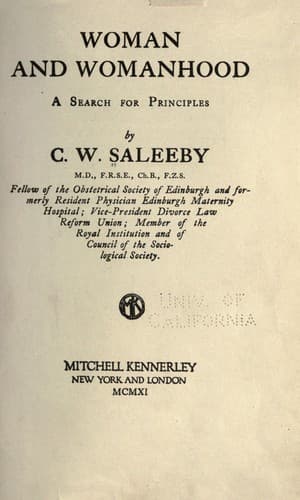
Woman and Womanhood: A Search for PrinciplesSaleeby, C. W. (Caleb Williams)
Science
Woman and Womanhood: A Search for Principles
Saleeby, C. W. (Caleb Williams)
Eugenics; Women
When he set forth, with great daring, to write the "Principles of
Biology," Spencer was already at an advantage compared with the accepted
writers upon the subject, not merely because of his stupendous
intellectual endowment, but also because the idea of the conservation of
energy was a permanent guiding factor in all his thought. Thus it was,
one supposes, that this bold young amateur, for he was little more,
perceived in the light of the evolutionary idea of which he was one of
the original promulgators, a simple truth which had been unperceived by
all previous writers upon biology, from Aristotle onwards. It is in the
last section of his book that Spencer propounds his "law of
multiplication," depending upon what he calls the "antagonism between
individuation and genesis." As I have observed elsewhere, the word
antagonism is perhaps too harsh, and may certainly be misleading, for it
may induce us to suppose that there is no possible reconciliation of the
claims and demands of the race and the individual, the future and the
present. I believe most devoutly that there is such a reconciliation, as
indeed Spencer himself pointed out, and a central thesis of this book is
indeed that in the right expression of motherhood or foster-motherhood,
woman may and increasingly will achieve the highest, happiest, and
richest self-development. Thus one may be inclined to abandon the word
antagonism, and to say merely that there is a necessary inverse ratio
between "individuation" and "genesis," to use the original Spencerian
terms. This principle has immense consequences--most notably that as
life ascends the birth-rate falls, more of the vital energy being used
for the enrichment and development of the individual life, and less for
mere physical parenthood. We shall argue that, in the case of mankind,
and pre-eminently in the case of woman, this enrichment and development
of the individual life is best and most surely attained by parenthood or
foster-parenthood, made self-conscious and provident, and magnificently
transmuted by its extension and amplification upon the psychical plane
in the education of children and, indeed, the care and ennoblement of
human life in all its stages.
This law of Spencer's has been discussed at length by the present writer
in a previous volume,[2] and we may therefore now proceed to its notable
illustration in the case of womanhood and the female sex in general, as
made by Geddes and Thomson now more than twenty years ago. It is
surprising that the distinguished authors do not seem to have recognized
that their law is a special case of Spencer's; but one of them granted
this relation in a discussion upon the present writer's first eugenic
lecture to the Sociological Society.[3]
Public-domain text, read in full here on John Shaqi.
Reviews
Reviews
No reviews yet
Be the first to share your thoughts on this work.
Join the Discussion
Join the discussion
Sign in to leave a comment or review.
Sign InorCreate an account