Woman and Womanhood: A Search for Principles — John Shaqi
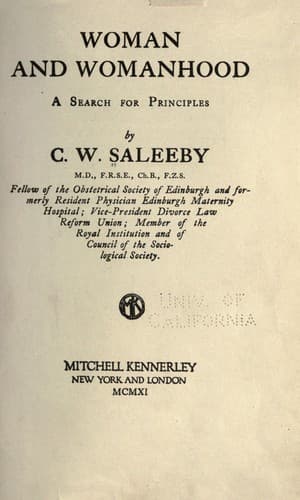
Woman and Womanhood: A Search for PrinciplesSaleeby, C. W. (Caleb Williams)
Science
Woman and Womanhood: A Search for Principles
Saleeby, C. W. (Caleb Williams)
Eugenics; Women
Thinkers in the past have known, and many critics in the present, though
unaware of the eugenic idea, do perceive, that woman can scarcely be
better employed than in the home. Herbert Spencer, notably, argued that
we must not include, in the estimate of a nation's assets, those
activities of woman the development of which is incompatible with
motherhood. To-day, the natural differences between individuals of both
sexes, and the importance of their right selection for the transmission
of their characters to the future, are clearly before the minds of those
who think at all on these subjects. On various occasions I have raised
this issue between Feminism and Eugenics, suggesting that there are
varieties of feminism, making various demands for women which are
utterly to be condemned because they not merely ignore eugenics, but are
opposed to it, and would, if successful, be therefore ruinous to the
race.
Ignored though it be by the feminist leaders, this is the first of
questions; and in so far as any clear opinion on it is emerging from the
welter of prejudices, that opinion is hitherto inimical to the feminist
claims. Most notably is this the case in America, where the dysgenic
consequences of the _so-called_ higher education of women have been
clearly demonstrated.
The mark of the following pages is that they assume the principle of
what we may call Eugenic Feminism, and that they endeavour to formulate
its working-out. It is my business to acquaint myself with the
literature of both eugenics and feminism, and I know that hitherto the
eugenists have inclined to oppose the claims of feminism, Sir Francis
Galton, for instance, having lent his name to the anti-suffrage side;
whilst the feminists, one and all, so far as Anglo-Saxondom is
concerned--for Ellen Key must be excepted--are either unaware of the
meaning of eugenics at all, or are up in arms at once when the
eugenist--or at any rate this eugenist, who is a male person--mildly
inquires: But what about motherhood? and to what sort of women are you
relegating it by default?
I claim, therefore, that there is immediate need for the presentation of
a case which is, from first to last, and at whatever cost, eugenic; but
which also--or, rather, therefore--makes the highest claims on behalf of
woman and womanhood, so that indeed, in striving to demonstrate the vast
importance of the woman question for the composition of the coming race,
I may claim to be much more feminist than the feminists.
The problem is not easily to be solved; otherwise we should not have
paired off into insane parties, as on my view we have done. Nor will the
solution please the feminists without reserve, whilst it will grossly
offend that abnormal section of the feminists who are distinguished by
being so much less than feminine, and who little realize what a poor
substitute feminism is for feminity.
Public-domain text, read in full here on John Shaqi.
Reviews
Reviews
No reviews yet
Be the first to share your thoughts on this work.
Join the Discussion
Join the discussion
Sign in to leave a comment or review.
Sign InorCreate an account