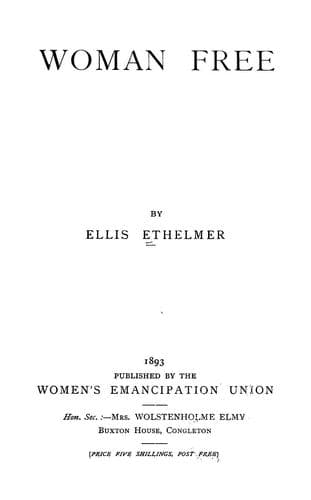
English poetry -- 19th century; Women -- History; Women -- Social conditions; Women -- Suffrage
_Id._... “I have urged on woman independence of man, not that I do not
think the sexes mutually needed by one another; but because in woman
this fact has led to an excessive devotion which has cooled love,
degraded marriage, and prevented either sex from being what it should be
to itself or the other.... Woman, self-controlled, would never be
absorbed by any relations; it would be only an experience to her as to
man. It is a vulgar error that love, a love to woman, is her whole
existence; she is also born for truth and love in their universal
energy.”—Margaret Fuller Ossoli (“The Woman of the Nineteenth Century”).
_Id._... Professor Alfred Russell Wallace has written an article,
concerning part of which Mr. W. T. Stead rightly says: “It is a
scientific reinforcement of the cause of the emancipation of women, and
shows that progress of the cause of female enfranchisement is identified
with the progress of humanity.”—(_Review of Reviews_, Vol. V., p. 177.)
Professor Wallace says:—
“When such social changes have been effected that no woman will be
compelled, either by hunger, isolation, or social compulsion, to sell
herself, whether in or out of wedlock, and when all women alike shall
feel the refining influence of a true humanising education, of beautiful
and elevating surroundings, and of a public opinion which shall be
founded on the highest aspirations of their age and country, the result
will be a form of human selection which will bring about a continuous
advance in the average status of the race. Under such conditions, all
who are deformed either in body or mind, though they may be able to lead
happy and contented lives, will, as a rule, leave no children to inherit
their deformity. Even now we find many women who never marry because
they have never found the man of their ideal. When no woman will be
compelled to marry for a bare living or for a comfortable home, those
who remain unmarried from their own free choice will certainly increase,
while many others, having no inducement to an early marriage, will wait
till they meet with a partner who is really congenial to them.
“In such a reformed society the vicious man, the man of degraded taste
or feeble intellect, will have little chance of finding a wife, and his
bad qualities will die out with himself. The most perfect and beautiful
in body and mind will, on the other hand, be most sought, and,
therefore, be most likely to marry early, the less highly endowed later,
and the least gifted in any way the latest of all, and this will be the
case with both sexes.
“From this varying age of marriage, as Mr. Galton has shown, there will
result a more rapid increase of the former than of the latter, and this
cause continuing at work for successive generations will, at length,
bring the average man to be the equal of those who are now among the
more advanced of the race.”—“Human Progress, Past and Present” (_Arena_,
Jan., 1892).
XLVII.
Public-domain text, read in full here on John Shaqi.
Reviews
Reviews
No reviews yet
Be the first to share your thoughts on this work.
Elsewhere in the archive
Join the Discussion
Join the discussion
Sign in to leave a comment or review.
Sign InorCreate an account