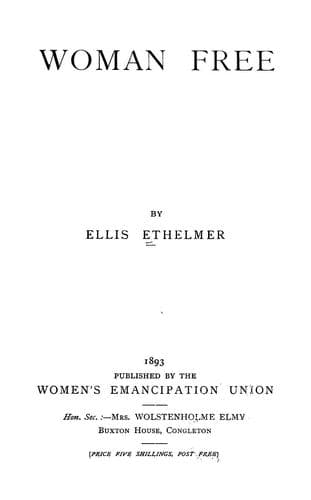
English poetry -- 19th century; Women -- History; Women -- Social conditions; Women -- Suffrage
“... pointed out the pineal gland, which Descartes thought to be the
seat of the soul, but which was now known to be an invertebrate eye.
He also explained the functions of certain small masses of grey
matter, which are two, viz.—sight and equilibration. The optic nerve
was situated close to the crura, and equilibration was subserved by
the cerebellum. After referring to the basal ganglia, Professor
Horsley admitted that as science advanced we seem to know less and
less about the specific functions of the various masses of grey
matter, and less definite views than formerly prevailed were now held
with respect to the local source of what are termed voluntary
impulses, and that of sensations.... We were still in ignorance as to
the functions of the optic thalamus, and of the corpus striatum. Those
of the cortex had to some extent been ascertained. They might be
divided into three classes, viz.—movement, sensation, and what was
termed mental phenomena. But we were still in the dark as to those
portions of the brain which subserved intellectual operations, memory,
and emotional impulses. A like ignorance prevailed with respect to the
basal ganglia.”
What as yet unrecognised inward eyes watch over the embryo life?
3.—“... _counsel helpful_ ...”
Mrs. Eliza W. Farnham says:—“In this day the most needed science to
humankind is that which will commend women to confidence in themselves
and their sex as the leading force of the coming Era—the Era of
spiritual rule and movement; in which, through them, the race is
destined to rise to a more exalted position than ever before it has
held, and for the first time to form its dominant ties of relationship
to that world of purer action and diviner motion, which lies above the
material one of intellectual struggle and selfish purpose wherein man
has held and exercised his long sovereignty.”—(“Woman and Her Era,” Vol.
I., p. 311).
5.—“... _philosophic lore_ ...”
“The farther our knowledge advances, the greater will be the need of
rising to transcendental views of the physical world.... If the
imagination had been more cultivated, if there had been a closer union
between the spirit of poetry and the spirit of science, natural
philosophy would have made greater progress because natural philosophers
would have taken a higher and more successful aim, and would have
enlisted on their side a wider range of human sympathies.”—Buckle
(“Influence of Women on the Progress of Knowledge”).
_Id._ “... _chirurgic lore_ ...”
“The Lady Dufferin fund had already been the means of opening a
school of medicine for Indian women, who would consequently devote
themselves to the study of anatomy. Anatomy and Asiatic women. That
was the most extraordinary association of ideas one could ever have
imagined.”—Professor Vambéry (Lecture to the Royal Scottish
Geographical Society, Edinburgh, 20th May, 1891). Reported in the
_Times_ of following day.
Public-domain text, read in full here on John Shaqi.
Reviews
Reviews
No reviews yet
Be the first to share your thoughts on this work.
Elsewhere in the archive
Join the Discussion
Join the discussion
Sign in to leave a comment or review.
Sign InorCreate an account