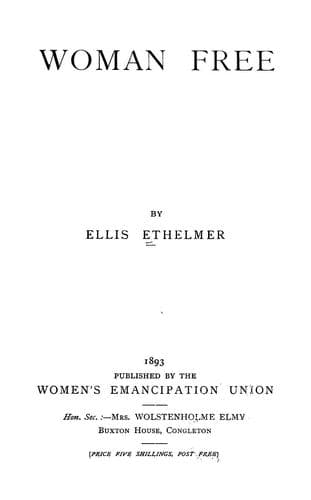
English poetry -- 19th century; Women -- History; Women -- Social conditions; Women -- Suffrage
_Id._... “My hope becomes as broad as the horizon afar, reiterated by
every leaf, sung on every bough, reflected in the gleam of every flower.
There is so much for us yet to come, so much to be gathered, and
enjoyed. Not for you or me, now, but for our race, who will ultimately
use this magical secret for their happiness. Earth holds secrets enough
to give them the life of the fabled Immortals. My heart is fixed firm
and stable in the belief that ultimately the sunshine and the summer,
the flowers and the azure sky, shall become, as it were, interwoven into
man’s existence. He shall take from all their beauty and enjoy their
glory.... He is indeed despicable who cannot look onwards to the ideal
life of man. Not to do so is to deny our birthright of mind.”—R.
Jefferies (“The Pageant of Summer”).
7, 8.—“... _mould their dreams of love, with conscious skill
To human living types_ ...”
“Her Brain enlabyrinths the whole heaven of her bosom and loins
To put in act what her Heart wills.”
—William Blake (“Jerusalem”).
“These states belong so purely to the inner nature; are so deeply hidden
beneath the strata of what we call the inner life, even, that only
women, and of these, only such as have become self-acquainted, through
seeing the depths within the depths of their own consciousness, can
fully comprehend all that is meant in the words a ‘Purposed Maternity.’
I use them in their highest sense, meaning not the mere purpose of
satisfying the maternal instincts, which the quadruped feels and acts
from, as well as the human being, but the intelligent, artistic purpose
(to which the maternal instinct is a fundamental motive), to act in
harmony with Nature in producing the most perfect being which the powers
and resources employed, can bring forth.... It is probable that we
shall, ere long, arrive at truer views of maternity everywhere; and when
we do, I think it will be seen that the office has a sacredness in
Nature’s eyes above all other offices, and that she reserves for it the
finest of her vital forces, powers, susceptibilities, and means of every
sort.”—Eliza W. Farnham (“Woman and Her Era,” Vol. II., p. 385; Vol. I.,
p. 93).
[It has been an intense delight to come upon these and the other words
and thoughts of Eliza W. Farnham; “blazes” or axe-marks of this previous
pioneer in the same exploration. It is only since completing the whole
of the verses that the writer has found the passages quoted from Mrs.
Farnham’s work, and deduces a not unnatural confirmation of the mutually
shared views, from the singular concord and unanimity of their
expression.]
8.—“... _supreme of form and will_.”
“The changes that have come over us in our social life during the past
two decades are, in many respects, remarkable, but in no particular are
they so remarkable as in the physical training and education of
women....
Public-domain text, read in full here on John Shaqi.
Reviews
Reviews
No reviews yet
Be the first to share your thoughts on this work.
Elsewhere in the archive
Join the Discussion
Join the discussion
Sign in to leave a comment or review.
Sign InorCreate an account