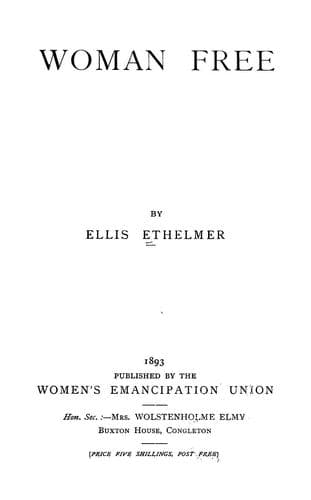
English poetry -- 19th century; Women -- History; Women -- Social conditions; Women -- Suffrage
“... They who discourse to you of the laws of nature as if those laws
were binding upon nature, or as if they formed a part of nature, deceive
both you and themselves. The (so-called) laws of nature have their sole
seat, origin, and function in the human mind. They are simply the
conditions under which the regularity of nature is recognised. They
explain the external world, but they reside in the internal. As yet we
know scarcely anything of the laws of mind, and, therefore, we scarcely
know anything of the laws of nature. We talk of the law of gravitation,
and yet we know not what gravitation is; we talk of the conservation of
force and distribution of forces, and we know not what forces are; we
talk with complacent ignorance of the atomic arrangements of matter, and
we neither know what atoms are nor what matter is; we do not even know
if matter, in the ordinary sense of the word, can be said to exist; we
have as yet only broken the first ground, we have but touched the crust
and surface of things. Before us and around us there is an immense and
untrodden field, whose limits the eye vainly strives to define; so
completely are they lost in the dim and shadowy outline of the future.
In that field, which we and our posterity have yet to traverse, I firmly
believe that the imagination will effect quite as much as the
understanding. Our poetry will have to reinforce our logic, and we must
feel as much as we argue. Let us then hope, that the imaginative and
emotional minds of one sex will continue to accelerate the great
progress, by acting upon and improving the colder and harder minds of
the other sex.”—Buckle (“Influence of Women on the Progress of
Knowledge”).
6.—“... _the vision to retain_,”
As with Wordsworth’s nature-nurtured maiden:—
“... beauty born of murmuring sound
Shall pass into her face ...
And vital feelings of delight
Shall rear her form to stately height ...
The floating clouds their state shall lend
To her; for her the willow bend,
Nor shall she fail to see
Even in the motions of the storm
Grace that shall mould the maiden’s form
By silent sympathy.”
—(“Poems of the Imagination”).
Public-domain text, read in full here on John Shaqi.
Reviews
Reviews
No reviews yet
Be the first to share your thoughts on this work.
Elsewhere in the archive
Join the Discussion
Join the discussion
Sign in to leave a comment or review.
Sign InorCreate an account