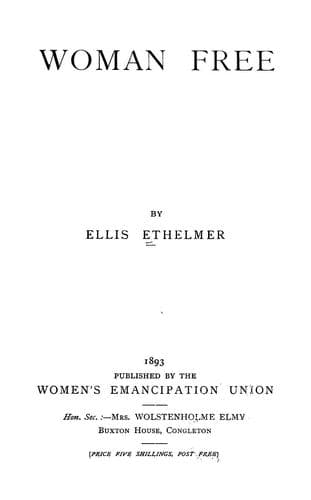
English poetry -- 19th century; Women -- History; Women -- Social conditions; Women -- Suffrage
“_Hetairai_, famous at once for their beauty and intellect such as
Phryne, Laïs of Corinth, Gnathæna, and Aspasia, were objects of
universal admiration among the most distinguished Greeks. They were
admitted to their assemblies and banquets, while the ‘honest’ women of
Greece were, without exception, confined to the house.... A considerable
number of women preferred the greater freedom which they enjoyed _as
Hetairai_ to marriage, and carried on the trade of prostitution as a
means of livelihood. In unrestrained intercourse with men, the more
intelligent of the _Hetairai_, who were doubtless often of good birth,
acquired a far greater degree of versatility and culture than that
possessed by the majority of married women, living in a state of
enforced ignorance and bondage. This invested the _Hetairai_ with a
greater charm for the men, in addition to the arts which they employed
in the special exercise of their profession. This explains the fact that
many of them enjoyed the esteem of some of the most distinguished and
eminent men of Greece, to whom they stood in a relationship of
influential intimacy, a position held by no legitimate wife. The names
of these _Hetairai_ are famous to the present day, while one enquires in
vain after the names of the legitimate wives.”—August Bebel (“Woman,”
Chap. I.).
7.—“... _wealth, or ... fame_.”
_E.g._, Phryne, who offered to rebuild the wall of Thebes; and Laïs,
commemorated in the adage, “_Non cuivis hominum contingit adire
Corinthum_.” And as to even modern “fame,” a writer so merciless
concerning her own sex as Mrs. Lynn Linton can yet say, “Agnes Sorel,
like Aspasia, was one of the rare instances in history where failure in
chastity did not include moral degradation nor unpatriotic
self-consideration.”—(_Nineteenth Century_, July, 1891, p. 84.)
8.—“... _the tinge of shame_.”
Why indeed should shame have attached specially to those women, more
highly cultured and better treated than wives; and whose sole
impeachment could be that they rejected the still lower serfdom of
wedded bondage?
XIII.
2.—“_To him who fixed the gages of the fight_.”
“If we could imagine a Bossuet or a Fénélon figuring among the followers
of Ninon de Lenclos, and publicly giving her counsel on the subject of
her professional duties, and the means of securing adorers, this would
be hardly less strange than the relation which really existed between
Socrates and the courtesan Theodota.”—Lecky (“History of European
Morals,” Vol. II., p. 280).
8.—“_The waste of woman worth_ ...”
Public-domain text, read in full here on John Shaqi.
Reviews
Reviews
No reviews yet
Be the first to share your thoughts on this work.
Join the Discussion
Join the discussion
Sign in to leave a comment or review.
Sign InorCreate an account