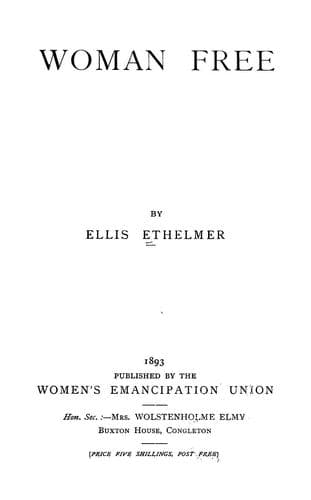
English poetry -- 19th century; Women -- History; Women -- Social conditions; Women -- Suffrage
_Id._... “Even supposing a woman to give no encouragement to her
admirers, many plots are always laid to carry her off. In the encounters
which result from these, she is almost certain to receive some violent
injury, for each of the combatants orders her to follow him, and, in the
event of her refusing, throws a spear at her. The early life of a young
woman at all celebrated for beauty is generally one continued series of
captivities to different masters, of ghastly wounds, of wandering in
strange families, of rapid flights, of bad treatment from other females
amongst whom she is brought, a stranger, by her captor; and rarely do
you see a form of unusual grace and elegance but it is marked and
scarred by the furrows of old wounds; and many a female thus wanders
several hundred miles from the home of her infancy, being carried off
successively to distant and more distant points.”—Sir George Grey
(“Travels in North-Western Australia,” 1841, Vol. II., p. 249; quoted in
M’Lennan on “Primitive Marriage,” p. 75).
5.—“... _her heart a gentle mien essayed_.”
“Woman seems to differ from man in mental disposition, chiefly in
greater tenderness and less selfishness, and this holds good even with
savages, as shown by a well-known passage in “Mungo Park’s Travels,” and
by statements made by other travellers. Woman, owing to her maternal
instincts, displays these qualities towards her infants in an eminent
degree; therefore it is likely that she should often extend them towards
her fellow creatures.”... “Mungo Park heard the negro women teaching
their young children to love the truth.”—Darwin (“The Descent of Man,”
Chaps. IX., III.).
6.—“_By deeper passion, holier impulse, swayed_.”
Mrs. Eliza W. Farnham well says:—“Woman has accepted her subordinate
lot, and lived in it with comparatively little moral harm, as the only
truly superior and noble being could have done. The masculine spirit,
enslaved and imprisoned, becomes diabolic or broken; the feminine, only
warped, weakened, or distorted, is ready, whenever the pressure upon it
is removed, to assume its true attitude.”—(“Woman and Her Era,” Part
IV.)
Public-domain text, read in full here on John Shaqi.
Reviews
Reviews
No reviews yet
Be the first to share your thoughts on this work.
Join the Discussion
Join the discussion
Sign in to leave a comment or review.
Sign InorCreate an account