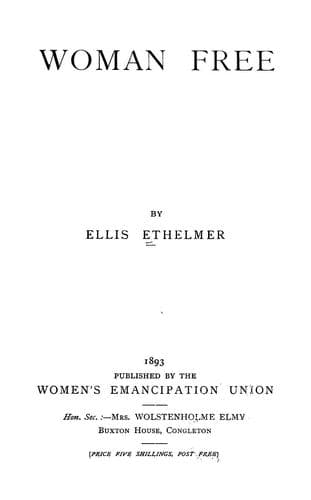
English poetry -- 19th century; Women -- History; Women -- Social conditions; Women -- Suffrage
Letourneau shows the state of feminine tutelage carried still further:
“We shall find that in many civilisations relatively advanced, widowhood
even does not gratify the woman with a liberty of which she is never
thought worthy.” And later on he quotes from the code of Manu, Book
V.:—“A little girl, a young woman, and an old woman ought never to do
anything of their own will, even in their own house.... During her
childhood a woman depends on her father; during her youth on her
husband; her husband being dead, on her sons; if she has no sons, on the
near relatives of her husband; or in default of them, on those of her
father; if she has no paternal relatives, on the Sovereign. A woman
ought never to have her own way.”—(“The Evolution of Marriage,” Chaps.
VII., XII.)
Can a man be esteemed a human or even a rational being, who would accept
or tolerate such terms for the life of his sister woman—the mother of
the generations to come?
See also Note XVII., 8.
XXXV.
1, 2.—“... _fearing that the slave herself might guess
The knavery of her forced enchainedness_.”
“Here I believe is the clue to the feeling of those men who have a real
antipathy to the equal freedom of women. I believe they are afraid, not
lest women should be unwilling to marry ... but lest they should insist
that marriage should be on equal conditions; but all women of spirit and
capacity should prefer doing almost anything else, not in their own eyes
degrading, rather than marry, when marrying is giving themselves a
master, and a master too of all their earthly possessions. And truly, if
this consequence were necessarily incident to marriage, I think that the
apprehension would be very well founded.”—J S. Mill (“The Subjection of
Women,” p. 51).
See also Note XL., 4.
5.—“... _dogmas_ ...”
These dogmas which, under the guise of religion, were imposed on the
acceptance of womanhood, may be aptly summarised and epitomised in the
following lines from one of the hierarchs of the system:—
“To whom thus Eve, with perfect beauty adorn’d:
‘My author and disposer, what thou bidd’st
Unargued I obey: so God ordains;
God is thy law, thou mine; to know no more
Is woman’s happiest knowledge, and her praise.’”
—(“Paradise Lost,” Book IV., 634.)
Concerning which words of Milton well may Mary Wollstonecraft observe,
with a quiet sarcasm:—“If it be allowed that women were destined by
Providence to acquire human virtues, and, by the exercise of their
understandings, that stability of character which is the firmest ground
to rest our future hopes upon, they must be permitted to turn to the
fountain of light, and not forced to shape their course by the twinkling
of a satellite.”—(“Vindication of the Rights of Woman,” Chap. II.)
Public-domain text, read in full here on John Shaqi.
Reviews
Reviews
No reviews yet
Be the first to share your thoughts on this work.
Elsewhere in the archive
Join the Discussion
Join the discussion
Sign in to leave a comment or review.
Sign InorCreate an account