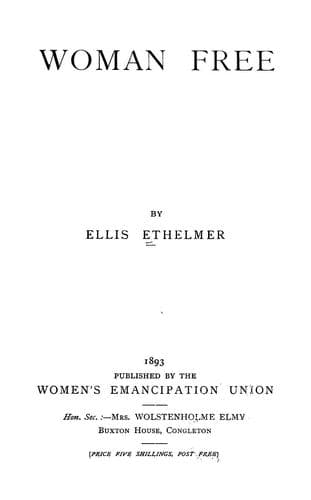
English poetry -- 19th century; Women -- History; Women -- Social conditions; Women -- Suffrage
_Id._... Buckle quotes from “Fergusson on the Epistles,” 1656, p.
242:—“The great and main duty which a wife, as a wife, ought to learn,
and so learn as to practice it, is to be subject to her own husband.”
(See also Note XVII., 8.) And Buckle further cites, from “Fox’s
Journal,” “After the middle of the seventeenth century the Quakers set
up ‘women’s’ meetings, to the disgust of many, and (query, because) in
the teeth of St. Paul’s opinion.”—(“Miscellaneous and Posthumous Works,”
Vol. I., pp. 375, 384.)
_Id._... As already said, the “sanctimonious” claim of “woman’s duty”
runs through all religions. Here, for instance, is what is reported in a
leader of the _Manchester Guardian_ of August 15th, 1892:—
“In this country no one would place suicide in the ranks of the
virtues. Here it is a crime, but in China under certain circumstances
it is regarded as an act of heroism and devotion worthy of sympathy
and of national recognition. Thus the Governor of Shansi forwarded to
the Emperor of China a memorial setting forth the virtues as daughter
and wife of a lady in that province. She was of good family, both her
father and grandfather having been officials in the district. At the
age of ten she showed her love for her mother in a peculiarly Chinese
fashion. One of the Celestial beliefs is that medicine acquires
efficacy by having mingled with it some human flesh, and the little
girl cut some from her own body to be used for the purpose of curing
an illness which threatened her mother’s life. In 1890 she was married
to an ‘expectant magistrate,’ whose expectations were realised by his
appointment last autumn to a judicial post. What she had, as a good
daughter, done for her mother, she, as a good wife, did also for her
husband, who fell ill; but her remedy was inefficacious, and he died.
She was now in a position which, according to the Chinese code of
ethics, has no responsibilities for a woman. Without parents, husband,
or children to demand her affectionate care, she decided to commit
suicide, and apparently not only communicated her intentions to those
around her, but had their sympathy and support in her decision. We are
told that, “only waiting till she had completed the arrangements for
her husband’s interment, she swallowed gold and powder of lead. She
handed her _trousseau_ to her relations to defray her funeral
expenses, and made presents to the younger members of the family and
the servants, after which, draped in her state robes, she sat waiting
her end. The poison began to work, and soon all was over.” The story
of a distracted wife seeking refuge in death from the sorrows of
widowhood might doubtless be told of any country in Europe, but the
sequel is possible only in China. The Governor of Shansi, struck with
the courage of the lady in what he evidently regards as a very proper
though somewhat unusual exhibition of conjugal affection, asks in his
Public-domain text, read in full here on John Shaqi.
Reviews
Reviews
No reviews yet
Be the first to share your thoughts on this work.
Elsewhere in the archive
Join the Discussion
Join the discussion
Sign in to leave a comment or review.
Sign InorCreate an account