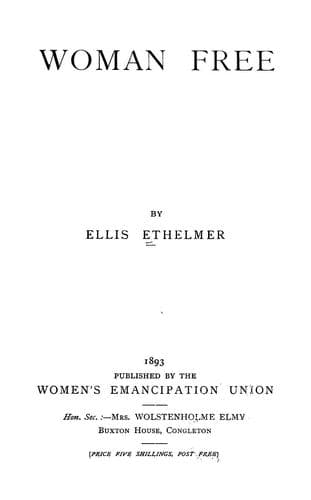
English poetry -- 19th century; Women -- History; Women -- Social conditions; Women -- Suffrage
The enforcement, or commendation, or acceptance of the practice of
prostitution, with its profanation of the dignity and individuality of
woman, and its utter carelessness and disregard for either her physical
or intellectual well-being, is indubitable evidence of the man-made
(_i.e._, male) origin of such a scheme of religion or ethics or
economics. For, as Mrs. Eliza W. Farnham truly remarks:—“If a doubt yet
remains on the mind of any reader that I have stated truly the part of
the masculine as cause in this terrible phenomenon, let it be considered
how man has always introduced prostitution in every country that he has
visited, and every island of the sea. Does anyone believe, for example,
that if the voyages of discovery and trade had been made by women
instead of men, to the islands of the Pacific, this scourge would have
been left as the testimony of their visit, so that, in a few
generations, the populations native there would have fallen a literal
sacrifice to their sensuality, as they are actually falling to man’s at
this day? There is no comment needed on the illustration, I am sure. The
common sense of every reader will furnish the best comment and answer
the question correctly.”—(“Woman and Her Era,” Vol. II., p. 299.)
_Id._... Lastly, but most convincingly, as to the wilful and intentional
degradation and subjugation of woman by the teaching and rites of
religion, let it be noted that, among the Jews, the very fact of being a
woman is made a disgrace; and woman, the mother of the human race, is
insulted accordingly. In the morning synagogue service of prayer,
directly after unitedly blessing “Adonai,” for bestowing on the
barn-door fowl the power to distinguish between night and day, and for
not having created the worshippers present heathens or slaves, each
member of the male portion of the congregation thanks the same Adonai
“that Thou hast not fashioned me as a woman,” while each member of the
segregated female portion of the company is instructed to submissively
give thanks “that Thou hast fashioned me after Thine own pleasure.” The
male thanks for not being heathens seem, under the circumstances,
conspicuously premature.—(See “Ohel Jakob,” _i.e._, “Jacob’s Temple,”
the “Daily Prayer of the Israelites,” Fraenkel’s ed., Berlin.)
That the spirit of this Mosaic or Hebrew sexual teaching, with its
incongruous assertions and inferences, has communicated itself deeply to
Christianity, may be observed from such passages as 1 Tim. ii. 13, 14; 1
Cor. vii., 9; Eph. v. 24; Col. iii. 18; 1 Pet. iii. 1, 5; and many
others.
Public-domain text, read in full here on John Shaqi.
Reviews
Reviews
No reviews yet
Be the first to share your thoughts on this work.
Elsewhere in the archive
Join the Discussion
Join the discussion
Sign in to leave a comment or review.
Sign InorCreate an account