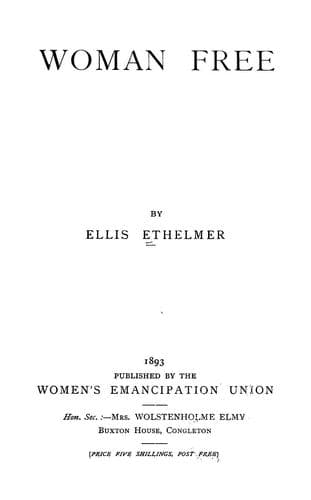
English poetry -- 19th century; Women -- History; Women -- Social conditions; Women -- Suffrage
The fact has been that male lawgivers, in whatever land, have generally
asserted for their code of feminine ethics or conduct a divine origin,
and have announced the punishment for breach thereof as a divine
injunction. In very few instances, indeed, was there any attempt to
decree an equal punishment to the male who was partner with the female
in a mutual breach of this morality, and very frequently no punishment
of the male attached at all; and even in the few cases where such a
punishment was nominally threatened, the man’s share in the offence was
most generally connived at, and passed unpunished. This double code of
morality has a flagrant exemplification in the English Law of Divorce,
by which, while a man can procure a Decree of Divorce on the simple
ground of the adultery of his wife, a woman cannot obtain a like decree
for her husband’s adultery unless that offence be accompanied by such
treatment of herself as the Court will recognise as “cruelty,” or with
“desertion.” The double scheme of sexual morality, so revoltingly
tolerated, in so far as man is concerned, by “society” in the present
day is too patent to need further words here. And the repulsive cant is
still that, while the man is allowed to go free, the punishment of the
woman is due and commendable as in accordance with “divine law.” (See
Note XIV., 3.)
XXXVII.
3, 4.—“... _lowest boor is lordly ‘baron’ styled,
And highest bride as common ‘feme’ reviled_.”
“... husband and wife; or, as most of our elder law books call them,
‘baron’ and ‘feme.’”—(Blackstone’s “Commentaries,” Bk. I. Chap. 15.)
But the context of the words “baron” and “feme” involved something more
than a mere _façon de parler_ of the law books. Edward Christian says,
in Note 23 to the Chapter in “Blackstone” above quoted:—“Husband and
wife, in the language of the law, are styled _baron_ and _feme_; the
word baron, or lord, attributes to the husband not a very courteous
superiority. But we might be inclined to think this merely an unmeaning
technical phrase, if we did not recollect, that if the baron kills his
feme it is the same as if he had killed a stranger or any other person;
but if the feme kills her baron it is regarded by the laws as a much
more atrocious crime, as she not only breaks through the restraints of
humanity and conjugal affection, but throws off all subjection to the
authority of her husband. And, therefore, the law denominates her crime
a species of treason, and condemns her to the same punishment as if she
had killed the king. And for every species of treason (though in petit
treason the punishment of men was only to be drawn and hanged), till the
30 Geo. III., Chap. 48, the sentence of woman was to be drawn and burnt
alive.”
Public-domain text, read in full here on John Shaqi.
Reviews
Reviews
No reviews yet
Be the first to share your thoughts on this work.
Elsewhere in the archive
Join the Discussion
Join the discussion
Sign in to leave a comment or review.
Sign InorCreate an account