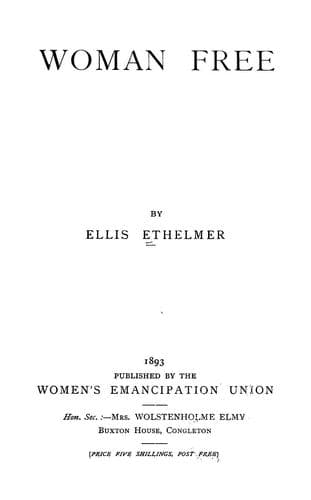
English poetry -- 19th century; Women -- History; Women -- Social conditions; Women -- Suffrage
And Mr. Courtney Kenny says, on the same point, that the English Law of
Marriage in the twelfth century had “clothed the humblest husband with
more than the authority of a feudal lord, and merged his wife’s legal
existence altogether in his own.”—(“History of the Law of Married
Women’s Property,” p. 8.)
And he exemplifies the position of the “feme” as being accurately
depicted in the words of Petruchio:—
“I will be master of what is mine own,
She is my goods, my chattels; she is my house,
My household stuff, my field, my barn,
My horse, my ox, my ass, my anything.”
—(“The Taming of the Shrew,” Act III., scene 2.)
The picture of the past masculine proprietorship and “bullyism” is
scarcely overdrawn. Ere a distant day Englishmen will shudder in
reflecting on the male creatures who were their progenitors.
5, 6.—“_The tardier fear that grants the clown a share
In his own governance, denies it her._”
By a leading article on Woman Suffrage, in the _Times_ of 29th April,
1892, a clear light is thrown on the causes which largely influenced the
extension of the Parliamentary franchise to the poorer class of male
citizens,—“a share of political power which they are not particularly
well fitted to use,” says the _Times_;—and which denied the same right
of franchise to women of whatever class. The intellect of the _Times_
enounces that—
“Without desiring to disparage the sex in any way, we must venture to
maintain that in both camps a large female contingent would be a
mischievous element. The female Conservative politician would be an
obstacle to all rational reform; the female Liberal politician would
be the advocate of every crude and febrile innovation. No doubt we
have put plausible arguments in the mouths of mere logic-choppers by
treating the franchise as a right rather than as a privilege and a
trust. Men can demand a share of _political power which they are not
particularly well fitted to use_, because they possess _de facto_ a
share of the physical force upon which all political arrangements
ultimately repose. Women do not possess such physical force, and,
therefore, can prefer no such claim.”
Passing over, as unworthy of serious refutation, the wild assertions due
to sex-bias in the first part of the above extract, it may be noted how
instantly the lauded masculine weapon of logic is discarded and
contemned as soon as it points in the direction of equal justice for
woman. The “physical force” question is further dealt with in Note XLV.,
6. But considering the words we have italicised, does not the whole of
the _Times_ exposition as above justify the appellation of cowardly
“fear”? (See also p. 78.)
_Id._... Yet an even more unworthy thing than denial of the suffrage has
taken place, in that English women have been really robbed of their
earlier franchises. A lady Poor Law Guardian of the Tewkesbury Union has
written:—
Public-domain text, read in full here on John Shaqi.
Reviews
Reviews
No reviews yet
Be the first to share your thoughts on this work.
Elsewhere in the archive
Join the Discussion
Join the discussion
Sign in to leave a comment or review.
Sign InorCreate an account