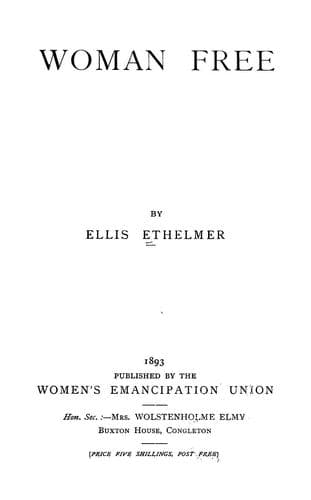
English poetry -- 19th century; Women -- History; Women -- Social conditions; Women -- Suffrage
XXXIX.
2.—“... _equal power of rule_ ...”
“Where women walk in public processions in the streets the same as the
men,
Where they enter the public assembly and take places the same as the
men; ...
Where the city of the cleanliness of the sexes stands,
Where the city of the healthiest fathers stands,
Where the city of the best bodied mothers stands,
There the great city stands.”
—Walt Whitman (“Song of the Broad Axe”).
3.—“_Her voice in council and in senate_ ...”
“Is there so great a superfluity of men fit for high duties, that
society can afford to reject the service of any competent person? Are we
so certain of always finding a man made to our hands for any duty or
function of social importance which falls vacant, that we lose nothing
by putting a ban on one half of mankind and refusing beforehand to make
their faculties available, however distinguished they may be? And even
if we could do without them, would it be consistent with justice to
refuse to them their fair share of honour and distinction, or to deny to
them the equal right of all human beings to choose their occupation
(short of injury to others) according to their own preferences, at their
own risk? Nor is the injustice confined to them, it is shared by those
who are in a position to benefit by their services. To ordain that any
kind of persons shall not be physicians, or shall not be advocates, or
shall not be members of parliament, is to injure not them only, but all
who employ physicians, or advocates, or elect members of parliament.”—J.
S. Mill (“The Subjection of Women,” p. 94).
4.—“... _harmonising word_ ...”
“... the main reason why so many thoughtful women now claim direct
Parliamentary representation is an unselfish one. They desire to take
their full share in the service of the race; to help to solve those
grave social problems now so urgently pressing, and which demand for
their solution the combined resources of the wisdom, experience, and
heart of both halves of humanity. They know that the time is fast
coming—if, indeed, it be not already come—which will need for its
direction and control something more than diplomatic cleverness or
political manœuvring, which will demand the clearer conscience and the
more sensitive perception of justice born of imaginative sympathy. It is
because they hope and believe that in virtue of their faculty of
motherhood they can contribute somewhat of these elements to the world’s
well-being, and can thus speed its progress towards a nobler future,
that they claim full right and power to follow and fulfil their highest
conceptions of duty.”—Elizabeth C. Wolstenholme Elmy (“The Decision in
the Clitheroe Case and its Consequences,” p. 17).
7.—“_Self-reverent each and reverencing each_.”
—A line from Part VII. of Tennyson’s “Princess.”
Public-domain text, read in full here on John Shaqi.
Reviews
Reviews
No reviews yet
Be the first to share your thoughts on this work.
Elsewhere in the archive
Join the Discussion
Join the discussion
Sign in to leave a comment or review.
Sign InorCreate an account