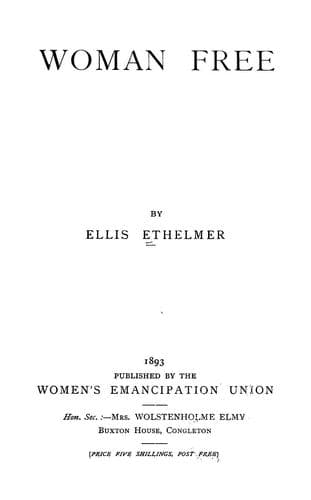
English poetry -- 19th century; Women -- History; Women -- Social conditions; Women -- Suffrage
_Id._... “The British _race_ cannot afford to dispense with _all_ the
advantage that may be in embryo in the future female intellect, because
men and some women are found who declare that women are intellectually
inferior.... No amount of prayers and wishes and submitting to God’s
will are of any avail. You must _use_ the organs of the intellect in
order, not only to increase their efficiency, but to prevent their going
from bad to worse. It might here be noted, that because the British
people might choose to be satisfied with atrophy of the intellect lobes
in their mothers, it will not at all follow that other nations will do
so _also_. If such things as nations exist, there will always be rivalry
and competition, and depend upon it those will be first whose mothers
generally possess the most efficient intellect lobes.... Fortunately we
have learnt another great lesson, evolved by Charles Darwin’s frontal
lobes, and that is, that there is no such thing as a _fixed_ and
_unalterable_ tissue or organism anywhere. All organisms and parts of
organisms are _changeable_. Everything—organ and organism—_has_ changed
in the past, _is_ changing in the present, and _will_ change in the
future in accordance with the conditions that surround it. Women’s
frontal lobes and grey matter will certainly be no exception to the
rule. Emancipation, keeping her eyes open, and thinking for herself are
the three main things she has to keep hammering at, until the lords of
creation _see_ that they are the right things to do, to save future
generations from universal imbecility.”—E. Bonavia, M.D. (“Woman’s
Frontal Lobes”).
2.—“_Their stalwart body and their spacious mind_;”
“If she be small, slight-natured, miserable,
How shall men grow?”
—Tennyson (“The Princess,” Canto 7).
XLIII.
8.—“_Where lies her richest gift_, ...”
“As I have already said more than once, I consider it presumption in
anyone to pretend to decide what women are or are not, can or cannot be
by natural constitution. They have always hitherto been kept, as far as
regards spontaneous development, in so unnatural a state, that their
nature cannot but have been greatly distorted and disguised, and no one
can safely pronounce that if women’s nature were left to choose its
direction as freely as men’s, and if no artificial bent were attempted
to be given to it except that required by the conditions of human
society, and given to both sexes alike, there would be any material
difference, or perhaps any difference at all, in the character and
capacities which would unfold themselves.”—J. S. Mill (“The Subjection
of Women,” p. 104).
XLIV.
4.—“... _the freeman, equable_ ...”
“The freeman assuredly scorns equally to insult and to be
insulted.”—Alexander Walker (“Woman as to Mind,” p. 205).
XLV.
Public-domain text, read in full here on John Shaqi.
Reviews
Reviews
No reviews yet
Be the first to share your thoughts on this work.
Elsewhere in the archive
Join the Discussion
Join the discussion
Sign in to leave a comment or review.
Sign InorCreate an account