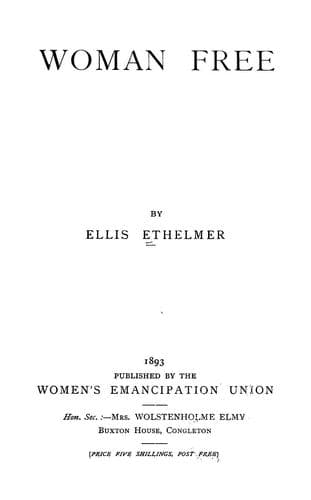
English poetry -- 19th century; Women -- History; Women -- Social conditions; Women -- Suffrage
2.—“... _equal freedom, equal fate_ ...”
“As long as boys and girls run about in the dirt, and trundle hoops
together, they are both precisely alike. If you catch up one half of
these creatures and train them to a particular set of actions and
opinions, and the other half to a perfectly opposite set, of course
their understandings will differ, as one or the other sort of
occupations has called this or that talent into action. There is surely
no occasion to go into any deeper or more abstruse reasoning in order to
explain so very simple a phenomenon.”—Sydney Smith (“Female Education”).
_Id._... “Was it Mary Somerville who had to hide her books, and study
her mathematics by stealth after all the family had gone to sleep, for
fear of being scolded and worried because she allowed her intellect full
scope? She has now a bust in the Royal Institution!... Whatever view of
the case theoretical considerations may suggest, there is one fact
beyond cavil, and it is this: that the female frontal lobes are not only
capable of equalling in power the male lobes, but can surpass them _when
allowed_ free scope. This has been recently proved in one of the
universities, where a woman surpassed the senior wrangler in
mathematics—an essentially intellectual work.”—Dr. Emanuel Bonavia
(“Woman’s Frontal Lobes”).
The “girl graduate” last referred to is Miss Philippa Fawcett at the
University Examinations, Cambridge, in June, 1890.
3.—“_Together reared_ ...”
“We find a good example in the United States, where, to the horror of
learned and unlearned pedants of both sexes, numerous colleges exist in
which large numbers of young men and women are educated together. And
with what results? President White, of the University of Michigan,
expresses himself thus: ‘For some years past a young woman has been the
best scholar of the Greek language among 1,300 students; the best
student in mathematics in one of the classes of our institution is a
young woman, and many of the best scholars in natural and general
science are also young women.’ Dr. Fairchild, President of Oberlin
College in Ohio, in which over 1,000 students of both sexes study in
mixed classes, says: ‘During an experience of eight years as Professor
of the ancient languages, Latin, Greek, and Hebrew, and in the branches
of ethics and philosophy, and during an experience of eleven years in
theoretical and applied mathematics, the only difference which I have
observed between the sexes was in the manner of their rhetoric.’ Edward
H. Machill, President of Swarthmore College, in Pennsylvania, tells us
that an experience of four years has forced him to the conclusion that
the education of both sexes in common leads to the best moral results.
This may be mentioned in passing as a reply to those who imagine such an
education must endanger morality.”—Bebel (“Women,” Walther’s
Translation, p. 131). (See also Notes to line 7, forward.)
Public-domain text, read in full here on John Shaqi.
Reviews
Reviews
No reviews yet
Be the first to share your thoughts on this work.
Elsewhere in the archive
Join the Discussion
Join the discussion
Sign in to leave a comment or review.
Sign InorCreate an account