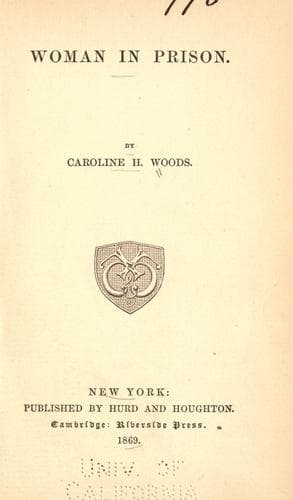
Prisons -- United States; Women prisoners -- United States
Many a one looked into her quart, as she passed me, and sighed out, "God
help us!"
"May He help you! He only can--I cannot," was my response; but not
always made audibly.
He only knew how I longed to do so. I often said to myself, as the days
passed on, I would not starve a dumb dog as those poor human things are
starved. I would not work a dumb animal as those poor human things are
worked! Nor would the Master feed his horse as they were fed; nor would
he stall him as those prisoners were lodged.
I did what I could for them. I asked the Deputy if he could not
substitute flour bread for the brown which they refused. He answered,--
"No! They will come to it. The Master will not change the order."
They did not come to it. And day after day, as I saw them go
breakfastless to their work, I wished,--was it wrong? perhaps so,--that
the avenger might be on the track of that unfeeling Master, and that the
day might come when he might be obliged to breakfast upon a quart of rye
coffee and a slice of brown bread, instead of the steaks, and eggs, and
toasts, and other delicacies that I saw carried to his room from the
kitchen, as I passed through it to the officers' dining-room.
If it aroused such indignation to witness such cruelty, what must it do
in the hearts of those who suffer from it! Does such correction of
convicts tend to arouse better purposes in their hearts than those which
brought them into prison? Such treatment aroused in them anger and
revenge. When they dared, and in every way which they could invent
without laying themselves liable to punishment, they gave expression to
their feelings.
When they were dismissed from the prison, the officer usually remarked,
"We shall have that boarder back again."
The answer that I should have made, had I spoken my thoughts, would have
been--The whole tendency of their discipline here is to produce that
end.
The first thing that I did, after breakfast was over, was to take the
names of my six kitchen women, and learn, as nearly as I could, just
what work belonged to each one of them.
There were two sink women, McMullins and Magill. Their work was to wash
the dishes, keep the sink clean, and scrub about one quarter of the
floor. The slide woman scrubbed the ration table, a certain portion of
the floor, washed the quarts and piled them up, scrubbed the table in
the centre of the room, took care of the flour bread when it came in,
and the pieces that were left. At meal time she passed out the coffee,
and put the potatoes in the ration pans.
The cook made the mush, which was boiled twice a day, the soup, and
hash, and stewed the peas. She had a certain portion of the floor to
scrub, and the room to keep tidy, as well as her boilers to wash.
The steam woman took care of the steam boiler, made the coffee, helped
the cook slice the meat, and kept her portion of the floor clean. It was
a part of her work to pile the ration pans in rows of pyramids on the
centre table.
Public-domain text, read in full here on John Shaqi.
Reviews
Reviews
No reviews yet
Be the first to share your thoughts on this work.
Join the Discussion
Join the discussion
Sign in to leave a comment or review.
Sign InorCreate an account