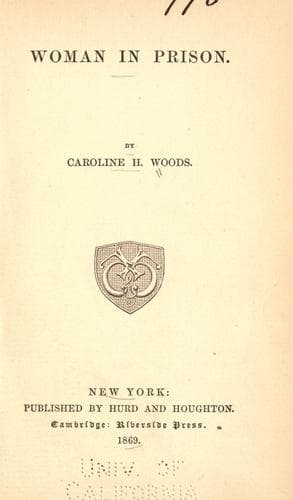
Prisons -- United States; Women prisoners -- United States
The names of the women who were going out during the month, with the
date of the day that they were to be discharged, was handed to the
Receiving Matron, the first of the month.
The women were very accurate, usually, in keeping account of their own
time, still they were anxious to have their own calculations confirmed
by knowing that their names were entered on the discharge list.
"If you will please look for me, I will do something for you after I go
out."
"Something for me, Mary! O no! I will look for you when I go to the
wash-room to-day."
Her remark called my attention to her work. I saw that she was doing a
beautiful piece of embroidery. When she saw that I noticed it, she held
it up and exhibited it with a great deal of pride.
It was a night-gown yoke, in linen, of an elegant and elaborate pattern.
"Who are you doing this for?" I asked.
"This is for Mrs. Means." That was the Housekeeper.
That is what I call you up two hours and a half before she rises, to do,
I thought.
"How many of you are there that can do such work?" I asked.
"Five of us can do this kind, and we can all do fine stitching, or
crochet, or some kind of fine needlework."
There were ten of them to do the work in the Housekeeper's rooms, and
those of the Supervisor. Quite an array of talent!
"You ought to see Ann Horton's work. She does all kinds beautifully. She
stays up-stairs, and works all of the time. She had a sentence of three
years; it's most out now. It would do your eyes good to see the piles
and piles of nice things she has done for the Master's wife and the
young ladies. The pillow-cases, and the yokes, and bands, and skirts."
"Has she been doing embroidery all of the time for three years?"
"Yes, ma'am, and nice sewing."
I thought three years of hard labor, from five in the morning till eight
at night, must accumulate quite an amount in value, of such work, beside
what was done at intervals of two or three hours at a time, by the other
nine women.
Supervisor might have exercised her thrift in supporting the
institution, very profitably, by selling that embroidery as she proposed
to do the moth-eaten rags. In doing that she might obviate the necessity
of giving the officers skimmed milk in their tea.
I inferred that that three years' labor was a perquisite belonging to
the office of Supervisor. In addition to her salary she was making a
profitable affair of her sinecure situation. Far more advantage would
accrue to her than to the institution in having such an incumbent.
Supervisor of what? Of her own housekeeping. The very best of
employments for a woman if she has a family.
XII.
SUNDAY.
It was Sunday morning. Sunday was our busiest day, because our meals
came so near together.
Public-domain text, read in full here on John Shaqi.
Reviews
Reviews
No reviews yet
Be the first to share your thoughts on this work.
Join the Discussion
Join the discussion
Sign in to leave a comment or review.
Sign InorCreate an account