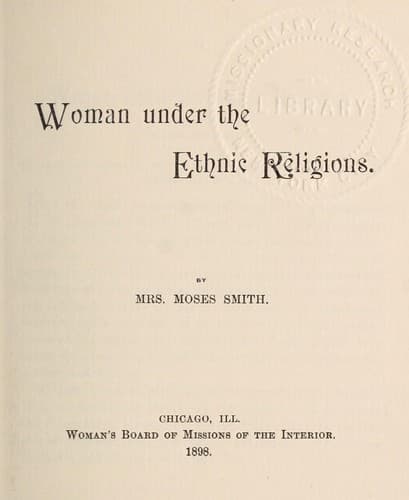
Woman under the ethnic religionsSmith, Moses, Mrs.
Religion
Woman under the ethnic religions
Smith, Moses, Mrs.
Women -- Religious life; Women and religion
“Let the wife who wishes to perform sacred oblation wash the feet of
her husband and drink the water, for the husband is to the wife greater
than Vishnu.” Again, “Women have no business with the text of a sacred
book, and having no evidence of law, and no knowledge of expiatory
texts, sinful women must be foul as falsehood itself, and this is a
fixed rule.”[3] And it has remained fixed for forty-three centuries.
[3] Dharma Sastra, chap. 5, page 155, 156.
[Sidenote: Seclusion.]
The modern Brahmans like to claim that the present custom of immuring
their wives in prison-like rooms had its origin in Mohammedan invasion.
This is certainly not the whole truth, for in the unalterable law of
Manu, written 900 years before Christ, we read, “A woman is not allowed
to go out of the house without the consent of her husband, she may not
laugh without a veil over her face or look out of a door or a window.”
“It may be that when the Mohammedans came, some fifteen centuries after
these laws had been in force, they put the crown on the arch already
waiting for them. They may have tightened the chains by which woman
was already enslaved,”[4] but the teachings of Manu are sufficient to
account for all we see in India to-day.
[4] Wilkins’ Modern Hinduism, page 326.
[Sidenote: Child Marriage.]
The people of the Western World have long wondered why the Hindus were
so tenacious of their, to us, revolting customs of child marriage.
It is only when we learn that it is not simply a custom but a part
of their religion that we apprehend the reason. The sacred laws of
the Hindu declare: “If a daughter is married at the age of six, the
father is certain to ascend to the highest heaven. If the daughter
is not married before seven, the father will only reach the second
heaven. If a daughter is not married until the age of ten, the father
can only attain the lowest place assigned the blest. If a girl is not
married until she is eleven years of age, all her progenitors for six
generations will suffer pain and penalties.”[5] When recently an effort
was made to induce the Government to raise the legal age of marriage to
twelve years, great excitement prevailed. The Brahmans set apart days
of fasting and prayer. Multitudes came in processions to the temples,
in some cases beating their breasts and calling aloud to the gods to
spare them from such calamity.
[5] Women of the Orient, page 135.
The worst feature of the system of child marriage is seen among the
Kulin Brahmans, the highest of all. Girls in these families must not
marry into a lower caste, and the supply of Kulins is limited, so
fathers who have not money to induce some young men to marry their
daughters, are compelled to give their little girls to those who make a
living by being husbands. Thus a child of twelve may be given as the
fortieth or fiftieth wife of some old man. Although it is certain she
will soon be a widow, even that is preferable to allowing her to remain
unmarried.
Public-domain text, read in full here on John Shaqi.
Reviews
Reviews
No reviews yet
Be the first to share your thoughts on this work.
Join the Discussion
Join the discussion
Sign in to leave a comment or review.
Sign InorCreate an account