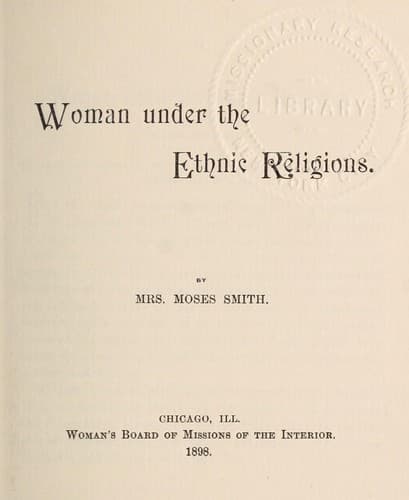
Woman under the ethnic religionsSmith, Moses, Mrs.
Religion
Woman under the ethnic religions
Smith, Moses, Mrs.
Women -- Religious life; Women and religion
From the hour of consecration the little thing is treated with peculiar
respect. She alone of the girls of the family is taught to read. When
she becomes ten or twelve years old, her father, mother and nearest
relatives take her to the great temple. They go with the priest into
the inner shrine. The girl places her hand into the god’s hand, the
priest repeats certain prayers and charms. He then hangs a string of
cowrie shells around the girl’s neck and the poor little thing repeats
after him her marriage vow, which vow is to prostitute herself to
any pilgrim to the shrine who demands it.[6] The position of these
religious prostitutes in Hindu society is so highly respectable that
no festival or wedding is celebrated without their presence. They are
asked to tie the wifely ornaments on the neck of the bride. They being
married to a god can never be widowed and their touch is lucky. In
elegant attire with costly jewels and perfumes, charmingly graceful,
they lead their wretched lives, bring great sums into the treasury of
the temple, and, as they are religiously taught, accumulate a store of
blessing for themselves in a future state. John Short, M. D., Surgeon
General of India, Member of Anthropological Society, London, says: “The
Nautch girl is recognized and patronized by the Hindu religion.”
[6] Prof. T. M. Lindsay, University of Glasgow.
There was a time in this fair eastern land when women were in a
position of respect similar to that among the ancient Hebrews. Husband
and wife were equal in all domestic, social and religious life. “The
Brahmans have themselves preserved the record of women engaging in
philosophical discussions, and disconcerting their most celebrated
doctors by the depths of their objections.”[7] Some of the Vedic
hymns were composed by women. By degrees the condition of woman has
deteriorated until by the law of their religion she is “now consigned
to a degradation probably without a parallel in the history of the
race.” It is true, Buddha, in the sixth century before Christ, taught
that men and women were equal, but even his influence has never been
strong enough to reform the Brahmanical laws about women. The Hindus
have a saying: “Education is good, as milk is good, but milk given to a
snake becomes venom, and education given to a woman becomes poison.”
[7] J. Murray Mitchell, LL. D.
Public-domain text, read in full here on John Shaqi.
Reviews
Reviews
No reviews yet
Be the first to share your thoughts on this work.
Join the Discussion
Join the discussion
Sign in to leave a comment or review.
Sign InorCreate an account