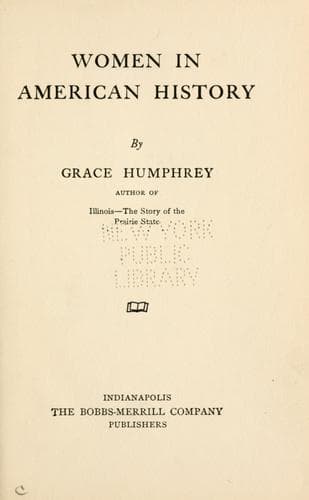
Women -- Biography; Women -- United States -- Biography
While they were in London, Lucretia Mott had a call from Clarkson, the
English abolitionist, then an old, old man of eighty-one, almost blind,
and they had a long talk together.
It is difficult for people of to-day to appreciate what peril and
reproach it meant to take a stand against slavery. Individuals who
dared to do so had to face private detraction and public abuse,
sometimes actual physical violence. On the side of slavery was
ranged all the power of trade and politics, of church and state, of
respectability and riot. This opposition became more and more bitter,
more and more popular, more and more widely spread. In equal or greater
ratio the earnestness and zeal of the anti-slavery group increased.
They were held up to odium and ridicule, for the spirit of persecution
was abroad. Lucretia Mott’s old friends scorned her and laughed at her.
They passed her on the street without speaking.
“But,” said she, “misrepresentation and ridicule and abuse heaped on
these reforms do not in the least deter me from my duty.”
Mobs of men and women would assemble outside the halls where
anti-slavery meetings were being held. They stoned the windows, they
broke in, leaped on the platform, and shouted so loudly that the
speaker’s voice was lost in the noise. Pennsylvania Hall, dedicated
to “liberty and the rights of man,” was surrounded by a crowd while
Lucretia Mott was addressing an audience of Philadelphia women, and
brickbats were hurled through the windows. The next day, shortly after
the meeting had adjourned, the mob set the hall on fire, then marched
through the streets, threatening an attack on the Motts’ house. The
children were sent away to a place of safety, and the little Quaker
lady, with her husband and a few friends, sat quietly waiting for the
crowd to come. But their fury was turned against another part of the
city and the Motts were safe for that night.
Shortly afterward they were sitting in the parlor one evening when they
heard confused noises and cries that came nearer and nearer--an angry
rumble hard to describe, but all too familiar to the experienced ears
of negroes and abolitionists. In the crowd was a young man who knew the
Quaker family. “On to the Motts’!” he cried, and purposely ran up the
wrong street, making several quick turnings. The rioters followed him
blindly until he slipped away from them, and a second time the Motts
were saved from violence.
In New York City an anti-slavery meeting was broken up by the crowd
and Garrison and other speakers roughly handled. Lucretia Mott, whose
fears and thoughts were never for herself, always unshrinking and
self-possessed in the stormiest scenes, noticed that some of the women
looked timid.
“Won’t thee look after the others?” she asked the gentleman who
accompanied her.
“Then who will take care of you?”
Public-domain text, read in full here on John Shaqi.
Reviews
Reviews
No reviews yet
Be the first to share your thoughts on this work.
Join the Discussion
Join the discussion
Sign in to leave a comment or review.
Sign InorCreate an account