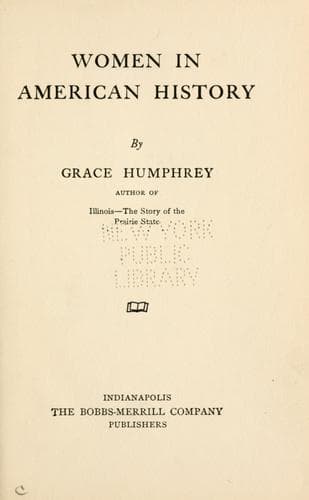
Women -- Biography; Women -- United States -- Biography
“This man will see me through,” she said, putting her hand on the arm
of a big ruffian in a red shirt. Roused by this unexpected appeal to
his chivalry he made way for her through the crowd and escorted her
safely to the house where she was staying.
The next day in a restaurant near the hall, she recognized him and
sitting down at his table began talking with him. When he left he asked:
“Who is that lady?”
“Lucretia Mott.”
Dumfounded for a moment he shook his head and then said, “Well, she’s a
good sensible woman!”
In her own home Lucretia Mott sheltered fugitive slaves, till it became
widely known as a place of refuge. Many a poor negro she helped on his
way to Canada, by the Underground Railroad. In the entrance hall of
the Mott house there stood two roomy armchairs which the family called
“the beggars’ chairs,” for there applicants, rich and poor, known and
unknown, black and white, waited to see Mrs. Mott.
Almost incredible was the opposition she met. Even the gentle Quakers
reproached her for “lugging in” slavery at their meetings. Many of
them wished she would resign. A minority wanted to disown her. They
refused the use of their meeting-houses for abolition lectures. When
she was speaking away from Philadelphia they allowed her to stay at
country taverns, instead of inviting her to their homes--a great breach
of hospitality. They discussed taking away her “approved minister’s
minute,” which introduced her to Quaker communities. But in justice
to herself, and because she loved the society and its traditions and
desired to remain a Friend, she was so careful that they could bring no
case against her.
Never did she compromise her principles. Never did she ask for police
protection, though the mob clamored and howled around the building.
And never did she meet bodily harm. She lived the Quaker doctrine
of non-resistance, and did not believe in repelling violence with
violence. Holding that slavery was wrong, the Motts decided to use
nothing made with slave labor. That meant giving up sugar and candy
and cotton cloth. Most of all, it meant giving up the cotton goods
commission business in which for the first time James Mott was finding
it possible to make a comfortable living. Yet unflinchingly they
sacrificed material prosperity for the spiritual gain. Mrs. Mott opened
a school and they managed to get along until a new business could be
established.
After the Civil War colored people were not allowed to ride in the
Philadelphia street-cars except in certain ones reserved for them.
One rainy day Lucretia Mott saw a negress, evidently in poor health,
standing on the platform in a cold drizzle. She asked the conductor
to let her enter the car, but he refused. Immediately Mrs. Mott went
outside and stood by the woman. The famous Mrs. Mott, seventy years
old, riding in the rain on the platform of his car? That would never
do! The conductor begged her to come in.
“Not without this woman--I can not!” was the reply.
Public-domain text, read in full here on John Shaqi.
Reviews
Reviews
No reviews yet
Be the first to share your thoughts on this work.
Join the Discussion
Join the discussion
Sign in to leave a comment or review.
Sign InorCreate an account