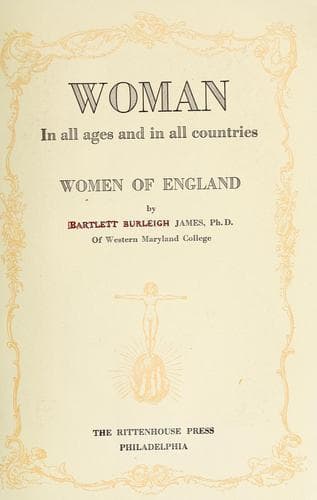
Women -- England -- History; Women -- Great Britain -- History
The distresses to which women were subjected by the peculiar form of
liberty which they enjoyed is illustrated by the following quotation
from an enactment in the Statute of Laborers in the reign of Edward
III: "Every man and woman of our realm of England, of what condition
he be, free or bond, able of body and within the age of threescore
years, not living in merchandise, not exercising any craft nor having
of his own whereof he may live, nor proper land about whose tillage
he may himself occupy, and serving any other, if he be in convenient
service (his estate considered), be required to serve, he shall be
bounden to serve him which so shall him require.... And if any such
man or woman being so required to serve will not the same do,... he
shall be committed to the next gaol, there to remain under strait
keeping, till he find surety to serve in the form aforesaid."
All of the oppressive enactments regulating the wages of laborers
and fixing the maximum of the sum that they were at liberty to accept
affected women equally with men. An enactment of Richard II. provided
"that no artificer, labourer, servant, nor victualler, man or woman,
should travel out of the hundred, rape, or wapentake where he is
dwelling, without a letter-patent under the King's seal, stating why
he is wandering, and that the term for which he or she had been hired
has been completed." Otherwise the offender might be put in a pair of
stocks, which was to be provided in every town.
The guild system, despite its attitude toward women, was the beginning
of the narrowing of her industrial sphere. Prior to the importation
of skilled laborers in textile and other branches of industry, such
activities were identified with the homes of the people, not merely in
that the industry itself was conducted in them, but that the product
was limited to the needs of the household, the demands of charity, and
such surplus as was used in trade. The guild broadened the meaning of
industry to meet the demands of a rising commercial system whose trade
routes became clearly established and extended throughout Europe and
into the East. So that, while the industry of the women artificers
became limited in that many things which had largely occupied their
hands became the settled occupations of men, the products which still
depended mainly upon their industrial activity became much more widely
dispersed, and made them factors in the developing industries to
which England is so deeply indebted for her trade supremacy. With the
decline of guilds, there was a return on a very large scale to the
system of home industry, when every farmstead and rural cottage became
a manufacturing centre. The development of the factory system of the
eighteenth century, upon the introduction of improved machinery for
manufacture, completely removed industry from the home and created the
modern factory town.
Public-domain text, read in full here on John Shaqi.
Reviews
Reviews
No reviews yet
Be the first to share your thoughts on this work.
Elsewhere in the archive
Join the Discussion
Join the discussion
Sign in to leave a comment or review.
Sign InorCreate an account