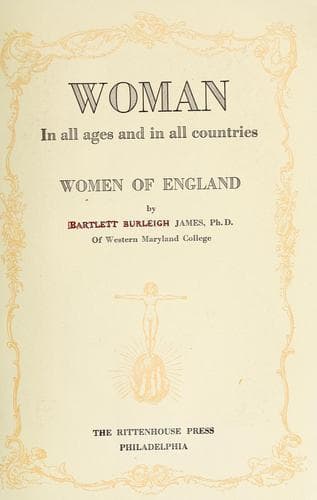
Women -- England -- History; Women -- Great Britain -- History
As the year has its seasons, marked by alternations of active growth
and recuperation for new development, so likewise has history. If the
Middle Ages were a time of comparative dearth as viewed in the light
of the modern era, certainly there was ample vitality hidden in the
quiet forms and the mechanical fixity of the period. The season of
vernal glory for England, which opened with the reign of Henry VIII.
and found its climax in that of Elizabeth, was glorious because the
beauty and brilliancy which characterized it were due to the splendid
utilities which were passed on to it from the Middle Ages. Art,
literature, and the pleasant pastimes of leisure--the affluence of
prosperity--are the efflorescence of a people's history, though the
absence of these graces and privileges of life may not mean a dearth
in any profound sense, for it may be that their absence but indicates
a lack of favoring conditions for the root stock to put forth foliage
and flower. The simple form of social life which obtained during the
Middle Ages, as contrasted with the brilliancy of intellect and the
breadth of view of the modern era, does not denote any important
difference in the character of the great mass of the English people,
any more than it can be said of the fallow land not under cultivation
that it has less productivity than the fields which by the waving
grain give evidence of their fertile worth.
The easy acceptance in modern times of the benefits of inventions
which greatly broaden the scope of living and add immeasurably to its
comfort shows how readily people adjust themselves to advances in the
conditions of life. So that which we look upon as an era was not so
considered by the people who witnessed the stimulus which we regard
as the beginning of all modern intellectual and social life. For
this reason, we need not expect to discover in the women of the early
modern period any radical difference from their sisters of preceding
generations; but we shall find that, with the change of environment
and the coming of a better state of life in general, womankind was
gradually and insensibly affected in ways of permanent improvement.
The opening up of new avenues of human interest and the enlargement of
old ones increased the sphere of woman's life and influence; yet had
it not been for the status she had achieved already, she would no more
have entered prominently into the blessings and privileges of the new
era than did the women of Greece generally benefit by the Golden Age
of Pericles.
Public-domain text, read in full here on John Shaqi.
Reviews
Reviews
No reviews yet
Be the first to share your thoughts on this work.
Elsewhere in the archive
Join the Discussion
Join the discussion
Sign in to leave a comment or review.
Sign InorCreate an account