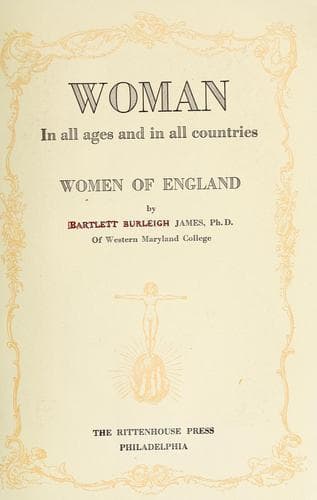
Women -- England -- History; Women -- Great Britain -- History
It is interesting to note that at the beginning of the modern era
population was increasing so slowly as to be practically stationary,
and, indeed, for generations past there had been no appreciable
increase. Even after the favorable conditions of the reign of Henry
VIII. became general, population made comparatively slow progress.
Families were not so numerous, or the number of their members so
great, as compared with to-day. It was an exception for a laborer to
maintain his family in a cottage to themselves. Farm work was commonly
done under the superintendence of country esquires, and the laborers
lived in the paternal cottage and remained single, marrying only when
by their providence they had managed to save enough to enable them
to enter upon some other career. The competition of other countries,
notably France, with the industries of England proved disastrous to
many forms of England's industrial activities; and to the introduction
into the kingdom of a number of wares and merchandise of foreign
make was attributed the great number of idle people throughout the
realm. To counteract this condition, Henry issued statutes for the
encouragement of manufacturing. One of these aimed to stimulate the
linen industry. In order that the men and women living in idleness,
which was styled "that most abominable sin," might have profitable
employment, it was ordained and enacted that every person should sow
one-quarter of an acre in flax or hemp for every sixty acres he might
have under cultivation. The immediate purpose of the act was to keep
the wives and children of the poor at work in their own houses, but it
also indicated that the condition of manufactures in England was not
such as to encourage an enlarging population.
The condition of the laboring classes during the reign of Henry VIII.
was not such as to excite general dissatisfaction; indeed, there are
evidences of a general state of contentment among the people. The laws
for the encouragement of trade and the sumptuary legislation for the
regulation of wages and prices were economic measures which may not
stand the test of examination according to modern ideas, but which
nevertheless tended, on the whole, to benefit those in whose behalf
they were made. Industry was the spirit of the times, and idleness was
the most abhorrent of vices. Men, women, and children, alike, were to
be trained in some craft or other, to prevent their becoming public
charges. The children of parents who could afford the fees which were
exacted for apprenticeship were set to learn trades, and the rest were
bound out to agriculture; and if the parents failed to see to it that
their children were started out in a career of labor, the mayors or
magistrates had authority to apprentice such children, so that when
they grew up they might not be driven to dishonest courses by want or
incapacity.
Public-domain text, read in full here on John Shaqi.
Reviews
Reviews
No reviews yet
Be the first to share your thoughts on this work.
Elsewhere in the archive
Join the Discussion
Join the discussion
Sign in to leave a comment or review.
Sign InorCreate an account