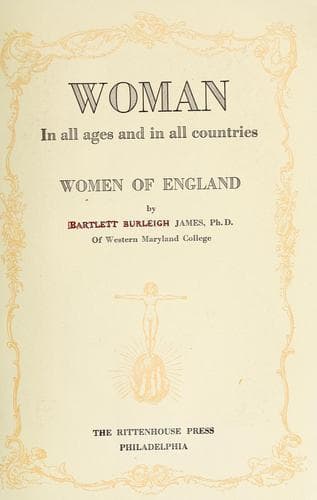
Women -- England -- History; Women -- Great Britain -- History
Hannah More was born in 1745, in a little village near Bristol. Her
father, who was the village schoolmaster, gave his five daughters
educations adapted as near as might be to the peculiar talents of
each. Three of the girls opened a boarding school in Bristol, when
the oldest was only twenty years of age. This school soon became
fashionable and ultimately famous. It was to this institution that
the early labors of Hannah More were given, and it was here that she
attracted the attention of such men as Ferguson the astronomer, the
elder Sheridan, Garrick the tragedian, Goldsmith, Reynolds, Burke, and
indeed nearly all men of eminence in intellectual and state life. But
her associations were not solely with the fashionable world, by which
she was petted and flattered, for she turned her attention to labors
for the poor and the ignorant. She sought to do for the children who
lived amid the savage profligacy of the peasant class what Madame
de Maintenon sought to do for girls of the aristocratic class in her
country. Both alike aimed to offset the perversion of character which
threatened the girls of their respective schools, from different
sources, but to the same end,--their destruction. Madame de Maintenon
worked to counteract the insidious infidelity that permeated the upper
walks of life--Hannah More, to counteract the practical atheism of
the lowest plane of life. The fundamental principle of her educational
system was the necessity of Christian instruction. She recognized
the close relationship of education and religion, and gauged well the
significance of the historical fact of woman's debt to Christianity
for her elevation. The question which she asked was not that of social
utility, but that of personal character. She saw too much of the
utilitarian principle in its actual workings, the reducing of human
life to the plane of mechanism, to permit her to base her educational
efforts upon a utilitarian foundation. She sought to cultivate that
"sensibility which has its seat in the heart rather than in the
nerves." Anything which detracted from modesty or delicacy, or tended
to make a girl bold or forward, she severely rebuked. She taught the
wastefulness of expending time upon the cultivation of a talent which
one does not possess, and held that excessive cultivation of the
æsthetic range of subjects contributes to a decline in those more
stable factors upon which is based the security of states. Neither
indelicate exposure of the person in style of dress nor extravagance
in dancing found favor at her hands. Such were some of the views which
were entertained and promulgated by the woman who created an epoch
in the attitude of society toward her sex. She taught the dignity of
womanhood, from which the duties of domesticity cannot detract, the
performance of them as a function of womankind being of all things
honorable. The pure common sense of Hannah More did for the women of
Public-domain text, read in full here on John Shaqi.
Reviews
Reviews
No reviews yet
Be the first to share your thoughts on this work.
Elsewhere in the archive
Join the Discussion
Join the discussion
Sign in to leave a comment or review.
Sign InorCreate an account