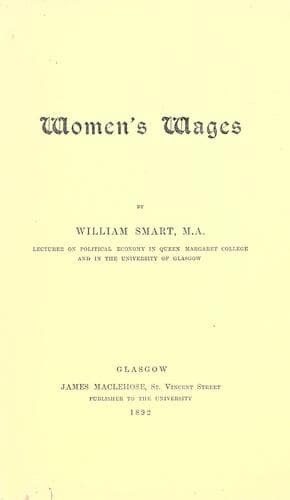
Equal pay for equal work; Sex discrimination against women; Wages -- Women
The reasons may be found in observing a course of events constantly
under our eyes. There are always certain trades where women are still
competing more or less directly with men. In these, women are under
certain disabilities of sex which make their work less remunerative or
less profitable to their employers. They are, as I said, physically
weaker; subject to little ailments which make them less regular in
attendance; more liable to distraction of purpose; perhaps worse
educated; and, probably, more slipshod in their methods. They get less
wages because, either in quantity or quality or both, their work is not
so good. This competition of the women tends to drag down wages for both
sexes, and, as a consequence, men hive off to trades where there is more
opportunity, or retain certain better-paid branches within trades, and
certain trades or branches of trades are left to women. Whenever this is
the case the women lose the advantage of competing with workers who will
not accept wages under a certain level. Their disabilities, thus become
cumulative, are taken advantage of by unthinking or unscrupulous
employers, and all other employers are forced to follow.
If tailors and tailoresses are working side by side making coats and
vests indifferently, it is not difficult to understand why the men may
earn 20s. to the women's 15s. But if, in time, the men get all the
coats, and the women all the vests, we have a good reason why the
women's wage goes down to 10s., while the men's remains at 20s.
Or equally common is another course of events. A certain industry, we
shall suppose, has been worked exclusively by men. By a "happy"
invention machinery is introduced which can be tended perfectly well by
women. For a little time the dead weight of custom will probably retain
men to tend these machines, and the wage will certainly not fall below
the average wage of men generally, which we shall, for simplicity's
sake, put down at 20s. But, either gradually or as result perhaps of a
dispute or strike on the part of the men, women are introduced to tend
the machines. Does their pay bear any proportion to that of the men they
replace? It is quite certain that the women's remuneration will not be
determined by the 20s. wage which they displace, but will be fixed at
something like 10s. If we ask why, the only answer given is that 10s. is
the "customary wage" for women.
Public-domain text, read in full here on John Shaqi.
Reviews
Reviews
No reviews yet
Be the first to share your thoughts on this work.
Join the Discussion
Join the discussion
Sign in to leave a comment or review.
Sign InorCreate an account