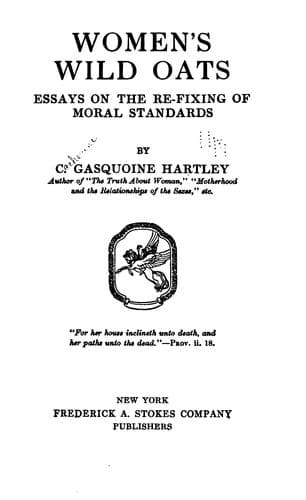
Women's Wild Oats: Essays on the Re-fixing of Moral Standards — John Shaqi
Women's Wild Oats: Essays on the Re-fixing of Moral StandardsHartley, C. Gasquoine (Catherine Gasquoine)
History
Women's Wild Oats: Essays on the Re-fixing of Moral Standards
Hartley, C. Gasquoine (Catherine Gasquoine)
Women -- Great Britain; Women -- Social and moral questions
In another passage the Committee report _that on piece work a woman will
always beat a man_. And again further on: _On mass production she will
come first every time.... Men will never stand the monotony of a fast
repetition job like women; they will not stand by a machine pressing all
their lives, but a woman will._[27:1]
Nothing that I can say, or any writer could say, could be more vividly
condemning than are these passages. They have filled me with so deep a
protest that really I can hardly trust myself to write any comment. This
is the ideal now set before us for the industrial woman "to stand by a
machine pressing all her life." I ask, Is it for this that the sons of
these women have died? Marriage is spoken of as "one of women's
industrial drawbacks," "it makes her less ambitious and enterprising."
Now, I do not wish to be unfair. The questions involved are, I know,
immense and many-sided. There can be no easy dismissal of this valuable
Report in condemnation. Mrs. Sidney Webb's minority Report[28:1] in
particular is valuable; and in many ways the findings of the Committee
are excellent. Everyone must agree with the wise recommendations as to
the reduction of the hours of work and better conditions of labor. They
are in advance of anything hitherto proposed. The popular formula of
"equal pay for equal work" or more correctly "equal value," is accepted.
If women are to do men's work, obviously they ought to be paid men's
wages. Other very commendable recommendations concern pensions for
widowed, deserted or necessitous mothers (I should add unmarried
mothers). State payment is advised for the entire cost of the
lying-in-period as the only way to ensure births under satisfactory
conditions to the child and the mother. All this is just and good. If
the state desires women to remain in industrial occupations, it is some
gain that help should be given them, when for a few weeks they go from
the factory to do their own work and bear children. Yet, after all, is
there not something ridiculous, yes, and also disgraceful, in such a
compromise. We leave a woman "to stand by a machine pressing all her
life" (a work of monotony, so nerve-exhausting and soul-deadening that
no man will do it), and then we pay her a small sum to enable her to
bear an enfeebled child. Afterwards we send her back to the factory and
open State creches and nursery-schools to rid her of the
responsibilities and joys of bringing up her child. Such miserable
makeshifts for fitting motherhood could be acceptable only in an
industrially ruled society, where the simple belief would seem to be
that _a woman can do everything that men won't do--and their own work as
well_.
IV
Public-domain text, read in full here on John Shaqi.
Reviews
Reviews
No reviews yet
Be the first to share your thoughts on this work.
Join the Discussion
Join the discussion
Sign in to leave a comment or review.
Sign InorCreate an account