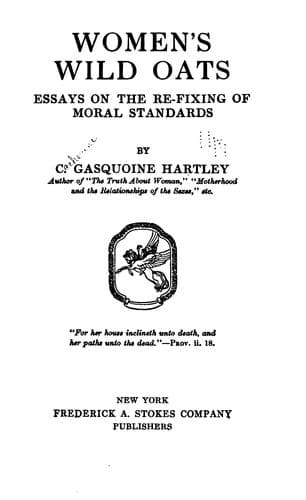
Women's Wild Oats: Essays on the Re-fixing of Moral StandardsHartley, C. Gasquoine (Catherine Gasquoine)
History
Women's Wild Oats: Essays on the Re-fixing of Moral Standards
Hartley, C. Gasquoine (Catherine Gasquoine)
Women -- Great Britain; Women -- Social and moral questions
In this medley the sense of the present tended to disappear. Victory
Night, by some fantastic transformation, to me became terrible with
menace. All the jostling, excited people, and especially the disheveled
women and the crowds of rioting girls, appeared as tormented puppets,
moving and capering, not at all from will and desire of their own, but
agitated violently and incessantly by some hidden hand, forced into
playing parts they did not want to play, saying words they had no wish
to speak, cutting antics for which they had no aptitude or liking.
Cruelties lurked everywhere, waiting in the confused mummery. Reality
was being left and with it the practical grasp of those powerful
simplicities that alone can guide life through confusion. I felt this
with stinging certainty. Everyone seemed playing a part, goaded with the
urgency of seeking an escape from themselves.
But must life always go on in the same way? Surely our great dead point
us through all these pretenses into the future? Dead compelling hands,
insisting with irritable gestures that this failure of life should
cease, and cease forever.
A thousand serried problems seemed to be pressing on me at once. My
young son was angry at my sadness, but it was the biting consciousness
of his presence that ruled my mood. This world was _his_ world; this
England _his_ England; this London was _his_ London and that of all
children. It was for them that the failure mattered. So I thought,
tormented, tortured with pain and impatience.
Leaving the Strand, we turned down one of the narrow streets near to the
Savoy Hotel, I forget which one it was, and walked to the Embankment. We
came out not far from Charing Cross Bridge and looked down over the long
sweep of the water. The evening sky was a dull gray, almost black, but
the rain had ceased to fall, and just then above us there was a break as
if the absent moon was working to cut the clouds adrift. A kind of
luminous darkness closed around us. It was beautiful. The massed
buildings rose a blurred outline between the river and the sky like
great beasts crouching and ready to spring, while through the
steel-black circlings of the bridge row after row of lights sparkled and
glowed, and blurs of color, amber to warm orange, splashed upon the
river. On the other side, behind us, the big hotels all were lighted,
and the unaccustomed illumination appeared to give too full a flood of
light to be quite real. Ever and anon rockets shot up into the gray and
fell in burning rain, and every color was reflected in diminishing
shades, above in that one luminous patch of sky, and below in the
pallid, rippled water. Yes, the scene was beautiful, perfect as a
dream-city one could desire; all the elements "composed" in the
painter's sense, and in arrogance of soul I felt that the beautiful
effect had been arranged for me: that it was like a faultless piece of
scene-painting, only there is no artist who could paint it.
Public-domain text, read in full here on John Shaqi.
Reviews
Reviews
No reviews yet
Be the first to share your thoughts on this work.
Join the Discussion
Join the discussion
Sign in to leave a comment or review.
Sign InorCreate an account