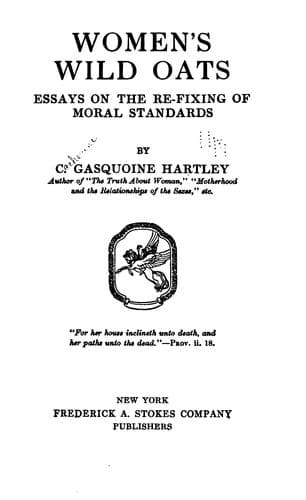
Women's Wild Oats: Essays on the Re-fixing of Moral StandardsHartley, C. Gasquoine (Catherine Gasquoine)
History
Women's Wild Oats: Essays on the Re-fixing of Moral Standards
Hartley, C. Gasquoine (Catherine Gasquoine)
Women -- Great Britain; Women -- Social and moral questions
Some people may be disposed to believe that this very absurdity and
unfairness of the law acts to prevent divorce. I tell you it does not;
what it does do is to render decent and honest conduct quite impossible.
I know this. I speak because the evil that is going on ought to be
known. My own opposition to the law is not so much on account of the
difficulty in obtaining a divorce--for it is not nearly so difficult as
most people think; nor do I take exception, as is common with most
women, to the unequal moral standard required from men and women; all
this, as I have said, can easily be got over if you have money and a
sufficiently clever lawyer. No, my passionate opposition is directed
against the trickery and dishonesty made necessary by the law.
Let me prove this statement. To do so I will give brief details of four
divorce suits which I think will speak more forcibly than any words of
mine; in each case I know the facts I give are true.
_Case 1._--_A husband and wife, childless, desired to part, there was no
physical infidelity on either side, but love had died. Both partners
desired to remarry. The wife proved desertion against the husband
(arranged between them beforehand by the help of a lawyer). She had to
write and urgently entreat the man she desired to leave her to return! A
decree for the restitution of conjugal rights was granted to her
petition. Afterwards the husband had to commit adultery; (again arranged
by the help of the lawyer.) He took the woman he wished to make his
second wife for one night to an hotel. The decree_ nisi _was granted.
Then there was the six months waiting for the decree to be made
absolute. The King's Proctor made inquiries, it was found that the wife
also desired her freedom; the divorce was refused on the ground of
collusion. Four people were rendered desperately unhappy, compelled
either to part or to live together without marriage. This, as was to be
expected, they did, and children were born, of necessity
illegitimately._
_Case 2._--_In this case the husband loved his wife, but she had been
unfaithful to him and desired freedom to re-marry her lover. There were
no children. Because it was better for her, this wronged husband
arranged for his wife to divorce him, prove desertion and adultery.
There was a slight difficulty because it was the wife who had run away
from home. However, this was easily got over. The wife wrote begging
the husband to allow her to come home, representing that he had sent her
away. He then had to reply refusing her request, and while desiring
nothing on earth so much as her return to him, had to state he would
never live with her again. An act of adultery was then necessary, and as
this good and chivalrous husband was also an exceptionally moral man, he
took his sister to an hotel, and the divorce was granted on this: they,
of course, signing their names in the hotel register as Mr. and Mrs. X._
Public-domain text, read in full here on John Shaqi.
Reviews
Reviews
No reviews yet
Be the first to share your thoughts on this work.
Join the Discussion
Join the discussion
Sign in to leave a comment or review.
Sign InorCreate an account