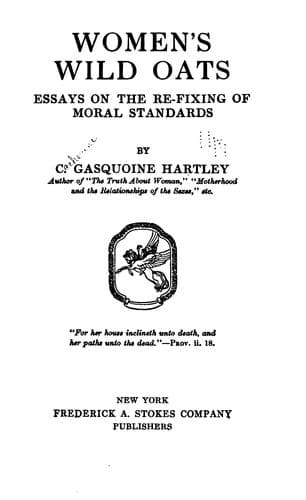
Women's Wild Oats: Essays on the Re-fixing of Moral StandardsHartley, C. Gasquoine (Catherine Gasquoine)
History
Women's Wild Oats: Essays on the Re-fixing of Moral Standards
Hartley, C. Gasquoine (Catherine Gasquoine)
Women -- Great Britain; Women -- Social and moral questions
I shall not wait to give you the many and overwhelming facts and figures
that I could bring forward in support of these statements. To-day all
the pitiful statistics of illegitimate births are widely known; at least
they are known intellectually, though I doubt their being known
emotionally, which is quite another matter and whips our indifference
into action. Only the workers in the darkest places of our great cities
know how large illegitimacy looms as a factor in the social
disintegration that leads to the prison, to the mad-house, to the
hospitals, to the casual wards, and to the streets. Only the eye of the
scientist can vision in the relation of the unhonored child to its
mother the seed of that evil which one day shall become the dishonor of
the dishonorable man.[170:1]
VIII
I can foresee an objection that will be made: it will be urged that much
of what I say of the unfitness of the average unmarried mother to train
her child is equally applicable to the average married mother. True: I
agree. There is, however, this all important difference. The child of
the married woman is not placed, either by circumstances or by the law,
in the power of its mother. It has a second parent: even if the father
is dead and its mother is the only parent, the home is watched by
grandmother, by grandfather--perhaps by four grandparents, by
sharp-eyed aunts and encouraging uncles; probably there are brothers and
sisters, cousins, great-aunts and great-cousins. There will also be a
more or less extensive circle of criticizing friends. Thus the baby is
surrounded from its birth by watchers--a veritable host of unpaid
inspectors. Now, you see my point and understand the immense difference.
It is the terrible loneliness of the child born illegitimately, outside
the safe publicity of marriage, without relations, belonging by right to
nobody, that makes the power given by law to its mother so dangerous.
That is why I would plead, with every power that I have, that we leave
sentiment behind us as we approach this question. We are a hopelessly
sentimental nation, and we cling to platitudes as a half naked beggar
will cling to his tattered shirt. We collect moral antiquities.
Inherited and worn-out ideas, psychological fossils, moral survivals,
these must be treasured only in romance; they must be deleted from life.
Every moral rule, every sentiment, as also every institution, must be
tested, from period to period, to see if it works still in a practical
and healthful direction to help the individual to do right and for the
betterment of the race.
IX
We English are sentimental.
Public-domain text, read in full here on John Shaqi.
Reviews
Reviews
No reviews yet
Be the first to share your thoughts on this work.
Elsewhere in the archive
Join the Discussion
Join the discussion
Sign in to leave a comment or review.
Sign InorCreate an account