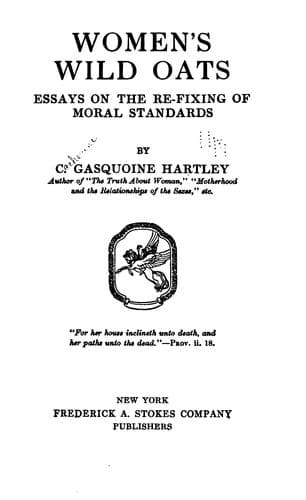
Women's Wild Oats: Essays on the Re-fixing of Moral StandardsHartley, C. Gasquoine (Catherine Gasquoine)
History
Women's Wild Oats: Essays on the Re-fixing of Moral Standards
Hartley, C. Gasquoine (Catherine Gasquoine)
Women -- Great Britain; Women -- Social and moral questions
Perhaps it is worth while to wait a moment to ask the cause of this
deeply-acting English sentimentality. It rests on two qualities, our
moderation and our exclusiveness. But the precise causes of these
qualities are not so certain; the English are romantic, but our
moderation prevents us being too impulsively romantic; on the other
hand, our homely _feeling for reality_ does not lead us to investigate
reality too deeply. We dislike the sordid and the "not nice." We are
imaginative and passionate, but our imaginations and passions are
carefully balanced by reasons and calm reflections. We are kindly, but
not to the extent of saintlike self-sacrifice; also we are selfish, but
again not to the extent of brutal egoism. Our exclusiveness makes "Birds
of a feather flock together" and at the same time fosters our ignorance
of, and indifference to, the existence of any other species of bird.
Thus the good know nothing of the bad; the people who drink, play
bridge, dance and have a fashionably good time, for instance, have
hardly heard of the meeting-frequenting, soul-worrying reformers who
live in Garden Suburbs. Thus in England there is very little to disturb
a comfortable feeling; protected by our moderation and exclusiveness,
there is no force inside from ourselves, or outside from observers, to
make us revise our position, consider the right or the wrong of our
moral attitude, to give up our illusions of comfort. That is one reason
why we so often stand aside from the ugly reality of things as they are,
"hold high the banner of the ideal," which is the untruthful way in
which we allude to things as we want them to be.
X
Now, all this leads up very directly to the special aspect of the
problem we are considering. We have to realize just what are the results
likely to follow from the close relationship of mother and child in the
case of the illegitimately born. Personally, I am certain that in most
cases the situation is one of quite appalling dangers.
I cannot feel sure that even the most helpful supervision of the mother,
if she and her child enter a hostel, or other institution, can, in the
majority of cases, save some hurt, if her character is unsteady, being
given by her to the child. We are only just now coming at all to
understand how immensely fateful to the whole later development are the
first few years of infant life, and further, how everything is
colored--it would be truer to say "decided"--by the character and
actions of the mother; how any hurt done, or mistake made then, can
never be undone. Even an unwise expression of too fond and emotional
affection may act to cause ruin in the after years. All who have even a
slight acquaintance with the enlightening work of Freud, will know the
folly of "trying to save the illegitimate mother through the agency of
the child."
Public-domain text, read in full here on John Shaqi.
Reviews
Reviews
No reviews yet
Be the first to share your thoughts on this work.
Elsewhere in the archive
Join the Discussion
Join the discussion
Sign in to leave a comment or review.
Sign InorCreate an account