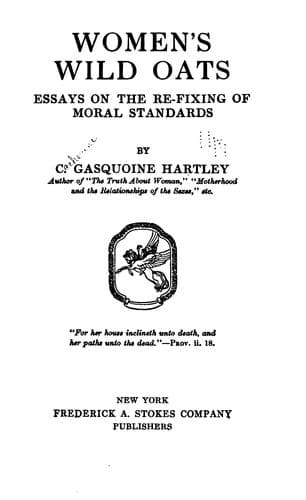
Women's Wild Oats: Essays on the Re-fixing of Moral StandardsHartley, C. Gasquoine (Catherine Gasquoine)
History
Women's Wild Oats: Essays on the Re-fixing of Moral Standards
Hartley, C. Gasquoine (Catherine Gasquoine)
Women -- Great Britain; Women -- Social and moral questions
I tell you women everywhere among us are being starved of sacrifice and
service. Sacrifice lives in the soul of a woman, and not alone in the
separate spirit of the individual woman to whom it is communicated only
through a losing of herself, which marks her union with the greatest
powers of life. It is, I think, one of the most destroying tragedies of
our industrial society that women are denied this sustenance in a fixed
and regulated unison of sacrifice, are forced away from service to life,
excited to do violence to their deepest instinct, by engaging in the
deadly and futile rivalry, where the greatest successfulness must bring
to them the greatest destruction.
There has been much happening to bring fear. Something has gone wrong
with the women of this land. In saying this, I am not forgetting the
splendidness of their work; what I complain of is that their womanly
vision has failed. In France, as is evident to all, the attitude of
women has been very different. The French women also worked hard during
the war to save their country, but they did not as our women have done,
_like war-work for its own sake_. They never transferred their
affections from their homes to the factories of war, they were too
certain of themselves, too content with their power as women to do
anything so foolish. What is the explanation of this profound difference
in attitude? Why has the vision of English women failed? That is the
question to which we have to try to find an answer.
II
The great part played by women coming forward during the war to take the
place of men called to the army is disclosed in a White Paper recently
issued by the Board of Trade. Over a million and a half women offered
their services, in addition to those already employed.[23:1] The
increase has been the highest in the occupations in which comparatively
few women were engaged before the war. In April, 1918, 701,000 women
were working on munitions and 774,000 in other industrial government
employment. A disturbing fact revealed (called, I note, in the Report an
_interesting point_!) is the number of women who have been engaged in
hard, laboring work. Before the war when the public discovered women
doing very hard work, it excited indignation and pity. The women
chain-makers of Craddock Heath, to cite one example, were accorded
general commiseration. But during the war our feelings on the question
would seem to have undergone a somewhat sudden transformation; a
complete turn-round has taken place in our attitude. Heavy work done by
women--foundry work, for instance, _demanding great expenditure of
physical strength_[24:1] has excited admiration and _become an important
factor of the industrial situation_. A glamour of patriotic war service,
added to the lure of high wages, has been thrown like a cloak of romance
over such exhibitions of female power. They became victories of female
will over female weakness.
Public-domain text, read in full here on John Shaqi.
Reviews
Reviews
No reviews yet
Be the first to share your thoughts on this work.
Join the Discussion
Join the discussion
Sign in to leave a comment or review.
Sign InorCreate an account