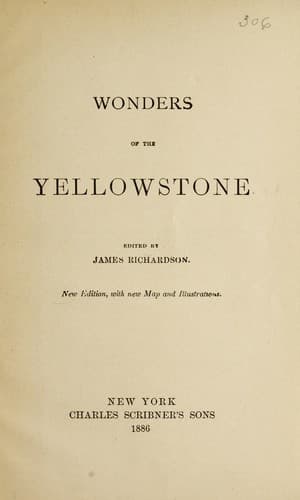
Wonders of the YellowstoneRichardson, James (Geologist)
History
Wonders of the Yellowstone
Richardson, James (Geologist)
Yellowstone National Park
"The climate during the months of June, July, and August, in this
valley, cannot be surpassed in the world for its health-giving powers.
The finest of mountain water, fish in the greatest abundance, with
a good supply of game of all kinds, fully satisfy the wants of the
traveller, and render this valley one of the most attractive places of
resort for invalids or pleasure-seekers in America."
From the summit of the ridge the party descended to the valley of the
Yellowstone, nearly opposite the mouth of the East Fork of that river.
The road was a rough one. During the period of volcanic action in this
region, the sedimentary rocks were crumpled into high, sharp, wave-like
series of ridges; from innumerable fissures, igneous matter was poured
out over the surface cooling into basalt; and from volcanic vents was
also thrown out, into the great lake, rock fragments and volcanic dust,
which were arranged by the water and cemented into a breccia. Deep into
these ridges the little streams have cut their channels, forming what
should be called valleys, rather than cañons, with almost vertical
sides. These ravines, 500 to 800 feet deep, covered mostly with grass
or trees, occur in great numbers, many of them entirely dry at present,
but attesting the presence and power, at no very remote period, of
aqueous forces compared with which those of the present are utterly
insignificant.
Before studying this portion of the Yellowstone Valley, it may be well
to retrace our steps to the mouth of Gardiner's River, to explore the
Third Cañon of the Yellowstone, so far as possible, and the rest of its
interesting valley up to this point.
Public-domain text, read in full here on John Shaqi.
Reviews
Reviews
No reviews yet
Be the first to share your thoughts on this work.
Join the Discussion
Join the discussion
Sign in to leave a comment or review.
Sign InorCreate an account