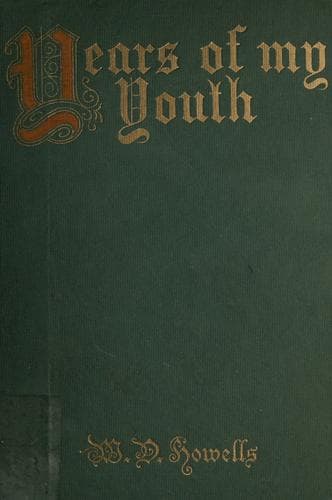
Howells, William Dean, 1837-1920 -- Childhood and youth
In one house there was more singing and playing and in another more
reading and talking. All the young ladies were beautiful, with the
supremacy of that young lady whom it was our poetry to hold so beautiful
that no other might contest it. As I believe the use still is in the
South, we called them Miss Lilly, Miss Julia, Miss Sally, Miss Fanny,
Miss Maggie, whether they were the older or the younger daughters of the
family. We were always meeting them at parties or, failing that or
including that, we went to call upon them at their houses. We called in
the evening and it was no strange thing for a young man to call every
evening of the week, not at one house, but at three or four. How, in the
swift sequence of the parties, we managed so often to find the young
ladies at home remains one of the mysteries which age must leave youth
to solve. Possibly in that sharply foreshortened perspective of the past
the parties show of closer succession than they really were.
At most of the houses we saw only the young ladies; it was they whom we
asked for; but there were other houses where the mothers of the family
received with the daughters, and at one of these my welcome was
immediately of a kindness and always of a conscience which it touches me
to realize. I was taken at the best I meant as well as the best I was by
the friend who was the exquisite spirit of the house, and made me at
home in it. My world had been very small, and it has never since been
the greatest, but I think yet, as I divined then, that she was of a
social genius which would have made her in any great-worldlier capital
the leader she was in ours, where her supremacy in that sort was no more
questioned than the incomparable loveliness of that most beautiful girl
whom every one worshiped. Her house expressed her, so that when her home
finally changed to another the new house obeyed the magic of her taste
and put on the semblance of the first, with a conservatory breathing
through it the odor of her flowers and the murmur of the dove that lived
among them: herself a flower-like and birdlike presence, delicate,
elegant, such as might have been fancied of some fine, old-world
condition in a new-world reading of it. She lived to rule socially in a
community which attested its gentleness by its allegiance to her until
she was past eighty, but when I knew her first she was too young to be
titularly accepted as their mother by her stepdaughters and was known to
them as their cousin in what must have been her own convention; but I
suppose she liked to be not less than sovereign among her equals. With
me she was not only the kindest, but the most candid of my friends; my
literary journalism and later my literature may have been to her liking,
but she never flattered me for them when, as I now know, too much praise
had made me hungry for flattery. No young man such as I was then could
have had a wiser and faithfuler friend, and I render her memory my
Public-domain text, read in full here on John Shaqi.
Reviews
Reviews
No reviews yet
Be the first to share your thoughts on this work.
Elsewhere in the archive
Join the Discussion
Join the discussion
Sign in to leave a comment or review.
Sign InorCreate an account