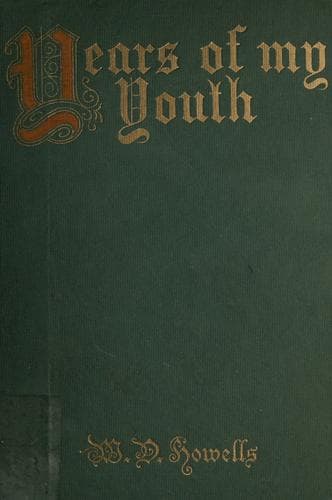
Howells, William Dean, 1837-1920 -- Childhood and youth
Journalism was not my ideal, but it was my passion, and I was
passionately a journalist well after I began author. I tried to make my
newspaper work literary, to give it form and distinction, and it seems
to me that I did not always try in vain, but I had also the instinct of
actuality, of trying to make my poetry speak for its time and place. For
the most part, I really made it speak for the times and places I had
read of; but while Lowell was keeping my Heinesque verses among the
_Atlantic_ MSS. until he could make sure that they were not translations
from Heine I was working at a piece of realism which when he printed it
in the magazine our exchange newspapers lavishly reprinted. In that
ingenuous time the copyright law hung loosely upon the journalistic
consciousness and it was thought a friendly thing to reproduce whatever
pleased the editorial fancy in the periodicals which would now
frowningly forbid it, but with less wisdom than they then allowed it, as
I think. I know that as its author the currency of _The Pilot's Story_
in our exchanges gave me a joy which I tried to hide from my senior in
the next room; and I bore heroically the hurt I felt when some of the
country papers printed my long, overrunning hexameters as prose. I had
studied the verse not alone in Longfellow's "Evangeline," but in
Kingsley's "Andromeda," and Goethe's "Hermann and Dorothea," while my
story I had taken from a potentiality of our own life, and in the
tragedy of the slave girl whose master gambles her away at _monte_ on a
Mississippi steamboat, and who flings herself into the river, I was at
home with circumstance and scenery. I still do not think the thing was
ill done, though now when I read it (I do not read it often) I long to
bring it closer to the gait and speech of life. The popularity of the
piece had its pains as well as pleasures, but the sharpest anguish I
suffered was from an elocutionist who was proposing to recite it on the
platform, and who came to me with it to have me hear him read it. He did
not give it with the music of my inner sense, but I praised him as well
as I could till he came to the point where the slave girl accuses her
master with the cry of--
"Sold me! Sold me! Sold! And you promised to give me my freedom!"
when he said, "And here I think I will introduce a shriek." "A shriek?"
I faltered. "Yes, don't you think it would fill the suspense that comes
at the last word 'Sold!'? Something like this," and he gave a screech
that made my blood run cold, not from the sensibility of the auditor,
but the agony of the author. "Oh no!" I implored him, and he really
seemed to imagine my suffering. He promised to spare me, but whether he
had the self-denial to do so I never had the courage to inquire.
Public-domain text, read in full here on John Shaqi.
Reviews
Reviews
No reviews yet
Be the first to share your thoughts on this work.
Elsewhere in the archive
Join the Discussion
Join the discussion
Sign in to leave a comment or review.
Sign InorCreate an account