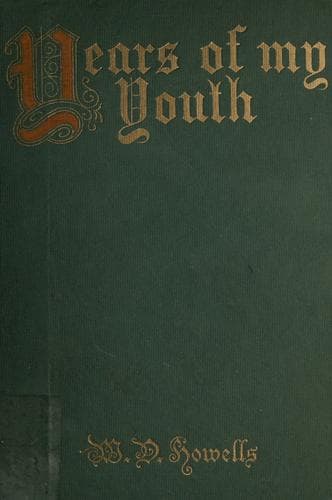
Howells, William Dean, 1837-1920 -- Childhood and youth
For a kindred reason I quite as altogether refused, and more explicitly,
the theory of my old friend, Moncure D. Conway, as to the true function
of the West in literature. He was then a young Unitarian minister,
preaching at Cincinnati an ever-widening liberalism in religion, and
publishing a slight monthly magazine named after _The Dial_ of Emerson
at Concord, and too carefully studied from it. For this paler avatar of
that transcendental messenger he had asked me for contributions, and so
a friendship, which lasted throughout our lives, sprang up between us.
When he once came to Columbus he came to lunch with me, and quite took
my appetite away by propounding his theory that the West was to live its
literature, especially its poetry, rather than write it, the East being
still in that darkling period when it could not live its literature. I
do not remember the arguments by which he supported his thesis; but
proofs as of holy writ could not have persuaded me of it as far as I
myself was concerned. My affair was to make poetry, let who would live
it, and to make myself known by both the quality and quantity of my
poetry. It is not clear to me now how I declared my position without
immodesty, but somehow I declared it, and so finally that Conway was
very willing to carry away with him for his magazine a piece of rhyme
which I had last made. He could the more willingly do this because _The
Dial_ was one of those periodicals, commoner then than now, that paid
rather in glory than in money; in fact it was not expected to pay
anything in money, so that I doubly defeated him: I was not only not
living my poetry, I was not even living by it.
IV
The days of the years when youth is finding its way into manhood are not
those which have the most flattering memories. It is better with the
autobiographer both before and after that time, though both the earlier
and later times have much to offer that should keep him modest. But that
interval is a space of blind struggle, relieved by moments of rest and
shot with gleams of light, when the youth, if he is fortunate, gathers
some inspiration for a worthier future. His experiences are vivid and so
burnt into him that if he comes to speak of them it will require all his
art to hide from himself that he has little to remember which he would
not much rather forget. In his own behalf, or to his honor and glory, he
cannot recall the whole of his past, but if he is honest enough to
intimate some of its facts he may be able to serve a later generation.
His reminiscences even in that case must be a tissue of egotism, and he
will merit nothing from their altruistic effect.
I
Public-domain text, read in full here on John Shaqi.
Reviews
Reviews
No reviews yet
Be the first to share your thoughts on this work.
Elsewhere in the archive
Join the Discussion
Join the discussion
Sign in to leave a comment or review.
Sign InorCreate an account