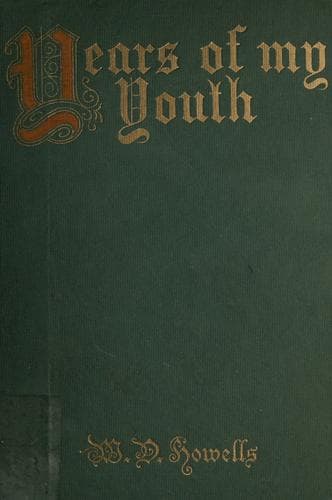
Howells, William Dean, 1837-1920 -- Childhood and youth
It is strange that within the time so dense with incident for us there
should have been so few incidents now separately tangible, but there is
one that vividly distinguishes itself from the others. In that past I
counted any experience precious that seemed to parallel the things of
fact with the things of fiction. Afterward, but long afterward, I
learned to praise, perhaps too arrogantly praise, the things of fiction
as they paralleled the things of fact, but as yet it was not so. I
suppose the young are always like us as we of the College dances were
then, but romance can rarely offer itself to youth of any time in the
sort of reality which one night enriched us amid our mirth with a wild
thrill of dismay at the shriek in a girl's voice of "Dead?" There was an
instant halt in the music, and then a rush to the place where the cry
had risen. Somebody had fainted, and when the fact could be verified, it
was found that one of the blithest of our company had been struck down
with word from home that her sister had fallen dead of heart failure.
Then when we began to falter away from the poor child's withdrawal,
suddenly another tumult stayed us; a young father, who had left his
first-born with its mother in their rooms above while he came down for
some turns in the waltz, could not believe that it was not his child
that was dead, and he had to be pulled and pushed up-stairs into sight
and sound of the little one roused from its sleep to convince him,
before he could trust the truth.
Here was mingling of the tragic and the comic to the full admired effect
of Shakespearian drama, but the mere circumstance of these esthetic
satisfactions would have been emotional wealth enough; and when I got
home on such a night to my slumbering room-mate Price I could give
myself in glad abandon to the control of the poet whose psychic I then
oftenest was, with some such result as I found in a tattered manuscript
the other day. I think the poet could hardly have resented my masking in
his wonted self-mocking, though I am afraid that he would have shrunk
from the antic German which I put on to the beat of his music.
"To-night there is dancing and fiddling
In the high windowed hall
Lighted with dim corpse-candles
In bottles against the wall.
"And the people talk of the weather,
And say they think it will snow;
And, without, the wind in the gables
Moans wearily and low.
[Illustration: _The quaint doorway of the Medical College through which
Mr. Howells passed daily while he roomed in the building_]
"'_Sa! Sa!_'--the dance of the Phantoms!
The dim corpse-candles flare;
On the whirl of the flying spectres
The shuddering windows stare.
"'Oh, play us the silent Ghost-Waltz,
Thou fiddling blackamoor!'
He hears the ghostly summons,
He sees the ghosts on the floor.
Public-domain text, read in full here on John Shaqi.
Reviews
Reviews
No reviews yet
Be the first to share your thoughts on this work.
Elsewhere in the archive
Join the Discussion
Join the discussion
Sign in to leave a comment or review.
Sign InorCreate an account