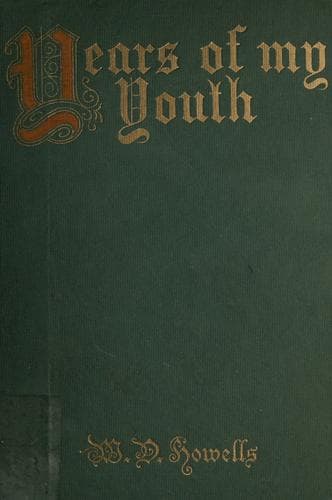
Howells, William Dean, 1837-1920 -- Childhood and youth
"He plays the silent Ghost-Waltz
And through the death-mute hall
The voiceless echoes answer,
In time the ghost-feet fall.
"Und immer und immer schneller,
Und wild wie der Winterwind
Die beide College Gespenster
Sie walzen sinnengeschwind.
"They waltz to the open doorway,
They waltz up the winding stair:
'Oh, gentle ghosts we are sneezing,
We are taking cold in the air.'"
XII
Very likely those dances lasted through the winter, but I cannot be
sure; I can only be sure that they summed up the raptures of the time,
which was the most memorable of my whole life; for now I met her who was
to be my wife. We were married the next year, and she became with her
unerring artistic taste and conscience my constant impulse toward
reality and sincerity in my work. She was the first to blame and the
first to praise, as she was the first to read what I wrote. Forty-seven
years we were together here, and then she died. But in that gayest time
when we met it did not seem as if there could ever be an end of time for
us, or any time less radiant. Though the country was drawing nearer and
nearer the abyss where it plunged so soon, few thought it would make the
plunge; many believed that when it would it could draw back from it, but
doubtless that was never possible; there is a doom for nations as there
is for men, and looking back upon our history I cannot see how we could
have escaped. The slaveholders in the old Union were a few hundred
thousand against many millions, but a force in them beyond their own
control incessantly sought to control the non-slaveholding majority.
They did not brook question of their will from others; they brooked no
self-question of it; however little they seemed at moments to demand,
they never demanded less than that conscience itself should come to
their help in making their evil our good. Having said that black was
white, that wrong was right, they were vitally bound to compel the
practical consent of humanity. It was what it had been aforetime and
must be to aftertime; Lincoln did not deny them in terms different from
Franklin's, but the case had gone farther. The hour had come when they
would not be denied at all; slavery could never keep its promises; it
could hardly stay even to threaten. Long before there had been dreams of
ending it by buying the slaves, but the owners would not have sold their
slaves, and now, though the war against slavery tried to believe itself
a war for the Union, when it came to full consciousness it knew itself a
war for freedom; such freedom, lame and halt, as we have been able to
keep for the negroes; a war for democracy, such democracy as we shall
not have for ourselves until we have an economic democracy.
Public-domain text, read in full here on John Shaqi.
Reviews
Reviews
No reviews yet
Be the first to share your thoughts on this work.
Elsewhere in the archive
Join the Discussion
Join the discussion
Sign in to leave a comment or review.
Sign InorCreate an account