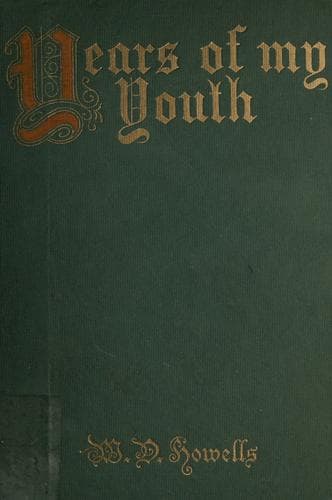
Howells, William Dean, 1837-1920 -- Childhood and youth
The prevision of the young writers on the _State Journal_ was of no such
reach as this retrospect. The best that could be said of them was that
so far as they knew the right, they served it, and it is no bad thing to
say of them that they met insolence with ridicule and hypocrisy with
contempt. Still, as always before in those columns, they got their fun
out of the opportunities which the situation offered, and they did not
believe the worst was coming; that would excuse their levity, and it
availed as much as gravity. I do not remember that we took counsel with
any one as to what we said or that we consulted much with each other. We
did not think that the Union would be dissolved, but if it should be we
did not think that its dissolution was the worst thing that could
happen; and this was the mind of vastly more at that day than most at
this day will believe; some of those who were of that mind then may not
like to own it now. People have the habit of saying that only those who
have lived through a certain period can realize it, but I doubt if even
they can realize it. A civic agitation is like a battle; it covers a
surface so large that only a part of it can be seen by any one spectator
at any one moment. The fact seems to be that the most of human motives
and actions must always remain obscure; history may do its best to
record and reveal them, but it will strive in vain to give us a living
sense of them, because no one ever had a living sense of them in their
entirety.
At the period which I am trying to tell of the hours passed and the days
and weeks and months, bringing us forever nearer the catastrophe; but I
could not truthfully say that their passing changed the general mood.
The College group which I used to consort with had changed, and it was
no longer so much to my liking; it had dwindled, and for me it chiefly
remained in the companionship of one friend, whom I walked and talked
with when I was not walking and talking with Price. This was that
protested and rejected Clive Newcome, of ours, who in real life was
James M. Comly, law student then, and then soldier, and then journalist.
Of all the friends in whose contrast I have been trying to find myself,
he was temperamentally the most unlike me, but a common literary bent
inclined us to each other. In his room there was not only euchre for
those who could not bear to waste in idleness the half-hours before
dinner or supper, but there were the latest fashions in such periodicals
as the _Cornhill Magazine_, then so brand new, and the _Saturday
Review_, equally new, with the great Thackeray stooping from his Jovian
height in the monthly to blunt against the weekly, with its social and
critical offensives, such bolts as calling it the _Superfine Review_.
Comly was of much the same taste as myself in authors, but not so
impassioned; he was not so multifarious a reader and not so inclusive of
the poets, and in obedience to his legalist instincts he was of more
Public-domain text, read in full here on John Shaqi.
Reviews
Reviews
No reviews yet
Be the first to share your thoughts on this work.
Elsewhere in the archive
Join the Discussion
Join the discussion
Sign in to leave a comment or review.
Sign InorCreate an account