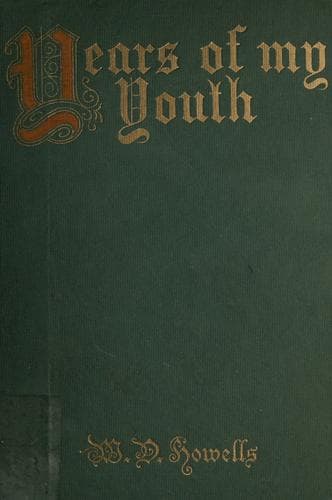
Howells, William Dean, 1837-1920 -- Childhood and youth
I had a most cheerful companion in my colleague, Price, who so loved to
laugh and to make laugh. If he never made the calls or went to the
parties to which I tempted him, apparently he found our own society
sufficient, and, in fact, I could not wish for anything better myself
than when, the day's work and the night's pleasure ended for me, we sat
together in the editorial-room, where our chief seldom molested us, and
waited for the last telegraphic despatches before sending the paper to
press. Sometimes we had the company of officials from the State House
who came over to while away the hours, more haggard for them than for
us, with the stories they told while we listened. They were often such
stories as Lincoln liked, no doubt for the humorous human nature and
racy character in them. Very likely he found a relief in them from the
tragedy overhanging us all, but not molesting our young souls with the
portents which the sad-eyed man of duty and of doom was aware of, or
perhaps not yet aware of.
The strangest impression that the time has left with me is a sense of
the patient ignorance which seemed to involve the whole North. Doubtless
the South, or the more positive part of it, knew what it was about; but
the North could only theorize and conjecture and wait while those who
were in keeping of the nation were seeking its life. In the glare of the
events that followed volcanically enough, it seems as if the North must
have been of the single mind which it became when the shot fired on Fort
Sumter woke it at last to the fact that the country was really in peril.
But throughout the long suspense after Lincoln's election till his
inauguration there was no settled purpose in the North to save the
Union, much less to fight for it. People ate and slept for the most part
tranquilly throughout; they married and gave in marriage; they followed
their dead to the grave with no thought that the dead were well out of
the world; they bought and sold, and got gain; what seemed the end could
not be the end, because it had never come before.
Public-domain text, read in full here on John Shaqi.
Reviews
Reviews
No reviews yet
Be the first to share your thoughts on this work.
Elsewhere in the archive
Join the Discussion
Join the discussion
Sign in to leave a comment or review.
Sign InorCreate an account