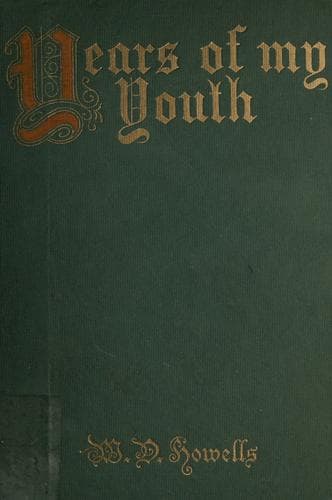
Howells, William Dean, 1837-1920 -- Childhood and youth
After the war actually began we could not feel that it had begun; we had
the evidence of our senses, but not of our experiences; in most things
it was too like peace to be really war. Neither of the great sections
believed in the other, but the South, which was solidified by the
slaveholding caste, had the advantage of believing in itself, and the
North did not believe in itself till the fighting began. Then it
believed too much and despised the enemy at its throat. Among the
grotesque instances of our self-confidence I recall the consoling
assurance of an old friend, a chief citizen and wise in his science, who
said, as the hostile forces were approaching each other in Virginia,
"Oh, they will run," and he meant the Southerners, as he lifted his fine
head and blew a whiff from his pipe into the air. "As soon as they see
we are in earnest they will run," but it was not from us that they ran;
and the North was startled from its fallacy that sixty days would see
the end of the rebellion, whose end no prophet had now the courage to
forecast. We of the Ohio capital wore a very political community, the
most political in the whole state, in virtue of our being the capital,
but none of the rumors of war had distracted us from our pleasures or
affairs, at least so far as the eyes of youth could see. With our faith
in the good ending, as if our national story were a tale that must end
well, with whatever suspenses, or thrilling episodes, we had put the
day's anxieties by and hopefully waited for the morrow's consolations.
But when the fateful shot was fired at Fort Sumter, it was as if the
echo had not died away when a great public meeting was held in response
to the President's call for volunteers, and the volunteering began with
an effect of simultaneity which the foreshortening of past events always
puts on to the retrospective eye. It seemed as if it were only the night
before that we had listened to the young Patti, now so old, singing her
sweetest in that hall where the warlike appeals rang out, with words
smiting like blows in that "Anvil Chorus" which between her songs had
thrilled us with the belief that we were listening to the noblest as
well as the newest music in the world.
I have sometimes thought that I would write a novel, with its scene in
our capital at that supreme moment when the volunteering began, but I
shall never do it, and without the mask of fiction one cannot give the
living complexion of events. Instantly the town was inundated from all
the towns of the state and from the farms between as with a tidal wave
of youth; for most of those who flooded our streets were boys of
eighteen and twenty, and they came in the wild hilarity of their young
vision, singing by day and by night, one sad inconsequent song, that
filled the whole air, and that fills my sense yet as I think of them:
"Oh, nebber mind the weather, but git ober double trouble,
For we're bound for the happy land of Canaan."
Public-domain text, read in full here on John Shaqi.
Reviews
Reviews
No reviews yet
Be the first to share your thoughts on this work.
Elsewhere in the archive
Join the Discussion
Join the discussion
Sign in to leave a comment or review.
Sign InorCreate an account