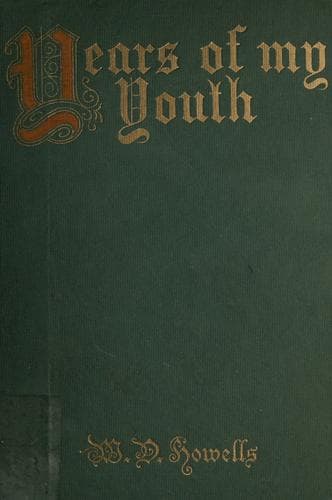
Howells, William Dean, 1837-1920 -- Childhood and youth
I have told in _My Literary Passions_ of the misanthropical Englishman
who led in our Dickens-worship and played the organ in the little
Episcopal church, and built the organs for such country churches about
as could afford to replace their moaning melodions with them. I have
said, I hope without too much attempt to establish the fact, that he was
also a house-painter, and that in the long leisures of our summer days
and winter nights and in the throes of his perpetual dyspepsia he was
the inveterate antagonist in argument of the vivid Yankee who built
steam-engines among us, and had taught school, and turned his quick head
and hand to any art or trade which making an easy living exacted of him.
They both lavishly lent me their books, and admitted me on equal terms
to their intellectual enmity and amity, which was shared in some tacit
way with a clever New England trader in watches, clocks, and jewelry. He
came and went among us on visits more or less prolonged from some
Eastern center of his commerce (my memory somehow specifies Springfield,
Massachusetts), and he had a shrewd smile and kindly twinkling eye which
represent him to me yet. He seldom took part in the disputes nightly
held at the drug-and-book store; but not from want of spirit, when he
had the boldness to deny some ferocious opinion exploded by the
organ-builder in an access of indigestion.
The disputes nearly always involved question of the existence of a God,
which was thought improbable by both of the debaters, and the
immortality of the soul, which was doubted, in spite of the spiritualism
rife in every second house in the village, with manifestations by
rappings, table-tippings, and oral and written messages from another
world through psychics of either sex, but oftenest the young girls one
met in the dances and sleigh-rides. The community was prevalently
unreligious; there was an ageing attendance at the Baptist and Methodist
churches, but there was no stated service of the Congregationalists,
though there was occasional preaching at their house and sometimes a
lecture from an anti-slavery apostle, who wasted his doctrine on a
community steeped in it already. Among many of the young people of the
village the prevalent tone was irreverent to mocking in matters of
religion; but their unlimited social freedom was without blame and
without scandal, and if our villagers were not religious, they were, in
a degree which I still think extraordinary, literary. Old and young they
read and talked about books, and better books than people read and talk
about now, as it seems to me, possibly because there were not so many
bad ones; the English serials pirated into our magazines were followed
and discussed, and any American author who made an effect in the East
became promptly known in that small village of the Western Reserve.
There were lawyers, of those abounding at every county-seat, who were
fond of reading, and imparted their taste to the young men studying law
in their offices.
Public-domain text, read in full here on John Shaqi.
Reviews
Reviews
No reviews yet
Be the first to share your thoughts on this work.
Elsewhere in the archive
Join the Discussion
Join the discussion
Sign in to leave a comment or review.
Sign InorCreate an account