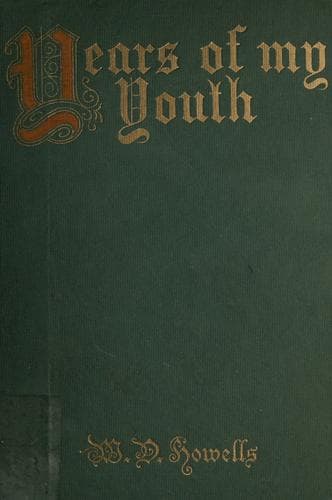
Howells, William Dean, 1837-1920 -- Childhood and youth
I might exaggerate the fact, but I do not think I have
done so, or that I was much deceived as to a condition which reported
itself, especially to me whose whole life was in books, through the
sympathy I met in the village houses. I was always reading whatever came
to hand, either with an instinct for what was good in my choice of books
or with good fortune in my chance of them. Literature was so commonly
accepted as a real interest, that I do not think I was accounted
altogether queer in my devotion to it. To be sure, at an evening session
in one of the dry-goods and grocery stores where question of me came up,
it was decided that I would be nowhere in a horse-trade, but this was a
rare instance of slight, and I do not believe that my disability would
have been generally counted against me.
XI
Somewhere about this time I gave a month to the study of law in the
office of the United States Senator dwelling among us. I have never
regretted reading a first volume of Blackstone through, or not going on
to the second; his frank declaration that the law was a jealous mistress
and would brook no divided love, was upon reflection quite enough for
one whose heart was given to a different muse. I was usually examined in
this author by the Senator's nephew, my fellow-student, whom I examined
in turn; but once, at least, the Senator himself catechized me, though
he presently began to talk about the four great English quarterly
reviews which I was known in the village for reading, and which it
seemed he read too. No doubt he found me more perfect in them than in
Blackstone; at least I felt that I did myself more credit in them. I
have elsewhere spoken more fully already of this episode of my life; but
I speak of it again because I think that the commonly accepted Wade
legend scarcely does justice to a man not only of great native power,
but of wider cultivation than it recognizes, and I would like to do what
I can to repair the injustice. He was famed in contemporary politics as
Old Ben Wade before he had passed middle life, and he was supposed to
stand up against the fierce pro-slavery leaders in Congress with an
intrepidity even with their own. He had a strong, dark face, and a deep,
raucous voice, with a defiant laugh, and these lent their support to the
popular notion of him as a rude natural force unhelped by teaching,
though he had taught himself in the days of his early struggle, as
Lincoln and most public men of his time had done, and later had taught
others as country schoolmaster. Farm-boy and cattle-drover and
canal-digger, more had remained to him from schoolmaster and medical
student, than from either of his other callings, and though he became
part of our history without the help of great intellectual refinement,
he was by no means without intellectual refinement, or without the
ability to estimate the value of it in others. Naturally he might also
underestimate it, and perhaps it was from an underestimate that he
Public-domain text, read in full here on John Shaqi.
Reviews
Reviews
No reviews yet
Be the first to share your thoughts on this work.
Elsewhere in the archive
Join the Discussion
Join the discussion
Sign in to leave a comment or review.
Sign InorCreate an account