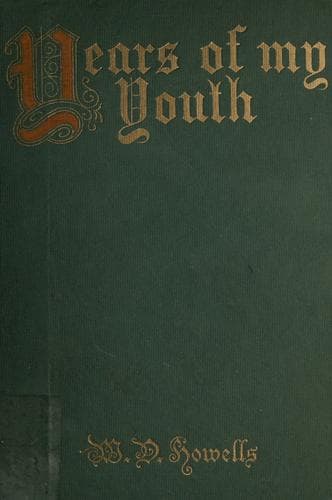
Howells, William Dean, 1837-1920 -- Childhood and youth
I believe she did not ask; that was forbidden by my pride and shame. I
did not read to any of them what I had been writing; they would not have
been hard enough upon it to satisfy me, though if they had criticized it
I should have been furious. In fact, I was not an amiable or at least a
reasonable youth; it was laid upon me to try solitarily for the things I
had no help in doing, and I seldom admitted any one to the results until
that sister of mine somehow passed my ungracious reserves. I do not know
just how this happened; but perhaps it was through our confiding to each
other, brokenly, almost unspokenly, our discontent with the village
limit of our lives. Within our home we had the great world, at least as
we knew it in books, with us, but outside of it, our social experience
dwindled to the measure of the place. I have tried to say how uncommon
the place was intellectually, but we disabled it on that side because it
did not realize the impossible dreams of that great world of wealth, of
fashion, of haughtily and dazzlingly, blindingly brilliant society,
which we did not inconveniently consider we were altogether unfit for.
The reader may or may not find a pathos in our looking at the
illustration on the front of a piece of tawdry sheet-music, and
wondering whether it would ever be our high fortune to mingle with a
company of such superbly caparisoned people as we saw pictured there,
playing and singing and listening.
Vanity so criminal as ours, might have been for a just punishment
lastingly immured in that village which the primeval woods encircled
like a prison wall; and yet almost at that moment, when we had so
tardily discovered ourselves akin in our tastes, our hopes and despairs,
we were nearer the end of our imprisonment than we could have imagined.
Whether we were punished in our enlargement which we were both so near,
I cannot say; my own life since that time has been such as some know and
any may know who care, and of hers I may scarcely speak. After a few
happy weeks, a few happy months of our common escape, she went back to
those bounds where her duty lay; and when after many years she escaped
from them again it was to circumstances where she was so willingly
useful as to feel herself very happy. Her last dream, one of being
usefuler yet to those dearest to her, ended in a nightmare of
disappointment; but that too had wholly passed before she woke to the
recompense which we try to believe that death shall bring to all who
suffer here to no final good.
Public-domain text, read in full here on John Shaqi.
Reviews
Reviews
No reviews yet
Be the first to share your thoughts on this work.
Elsewhere in the archive
Join the Discussion
Join the discussion
Sign in to leave a comment or review.
Sign InorCreate an account