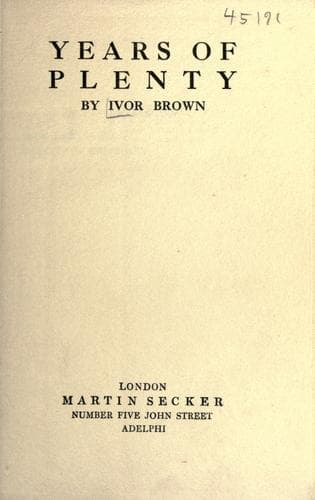
Boarding schools -- England -- Fiction; University of Oxford -- Fiction
And he was lonely now. He had rooms in narrow Ship Street, and there
he spent solitary days and nights craving the society of the Push:
sometimes one of them would come down for a week-end, but otherwise
there was scarcely anyone to whom he could talk. The winter crept on
dismally, and Martin studied Bengali or rode on horseback over Shotover
and Port meadow. But there was something wrong about Oxford: he felt
old and alien and the college, when he entered it, seemed to be
bubbling over with freshmen, all amazingly young and innocent and
happy. He was vaguely jealous of them, uncharitably hostile. Were
they not talking as he had talked, idling as he had idled? One friend
he had, a poet in his third year, discreet and practical. From time to
time Martin dined with him and forgot about India.
Most of all Freda mattered. Now that he was alone and despondent, he
relied on her letters and his memories and thoughts of her to make life
easier, even more tolerable. He retraced the whole course of their
friendship, trying to reshape their relations. He remembered her first
as an arguer, a friend to whom he had talked and talked: and then as a
martyr, the sufferer for whom he had felt with a genuine, unstinting
pity. And at last ... well, at last as a woman, as a person who had
the power of making life different, of turning London into an enchanted
fairyland and India into a vision of cool beauty, a person of infinite
tenderness and understanding, a person whose presence and sympathy
could stop things hurting. What rendered him most happy was his
ability to meet her on equal terms. Hitherto she had been
self-supporting, he a pampered undergraduate. He had had prospects but
no certainty, and he had shrunk, even on that summer night upon the
river, from saying things that he wanted to say, because he felt that
it wasn't fair. One couldn't honourably say these things until one was
'a made man': one couldn't decently make women expect things unless you
had some reasonable basis for hopes. With girls like May Williams it
didn't matter what one said, because he had been just a 'fellow,' she
just a 'girl.' Such affairs had their agreeable conventions. But with
Freda it had been different, because there was no such tacit agreement:
she might, she would expect him to take her out of her toil and
weariness. And now he was free to say and do as it pleased him. He
was 'made' and had position, for only by great folly and stupidity
could he lose his opportunity.
Public-domain text, read in full here on John Shaqi.
Reviews
Reviews
No reviews yet
Be the first to share your thoughts on this work.
Elsewhere in the archive
Join the Discussion
Join the discussion
Sign in to leave a comment or review.
Sign InorCreate an account