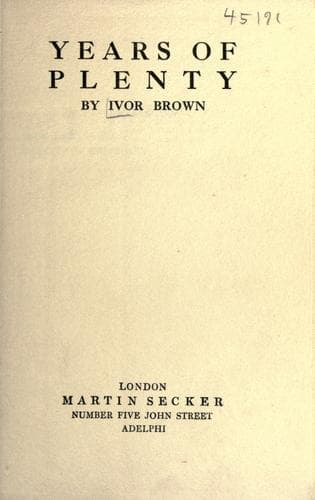
Boarding schools -- England -- Fiction; University of Oxford -- Fiction
"Isn't it splendid," said Mrs Foskett, "about the school athletics?
When we first came here Elfrey hardly ever won its school matches and
now we never get beaten. Fermor's play last summer was marvellous,
positively marvellous. D'you know, he actually got fifty wickets for
9.76 and had a batting average of 37. He's sure to get a blue at
Cambridge. The last Elfreyan to get a blue was Staples: he made 74 at
Lord's and was run out by an Old Etonian."
"Hard luck," said Caruth. "I do think being run out is rotten."
"Are you a cricketer?" continued Mrs Foskett.
"Well, I was captain of my preparatory school," said Caruth, assuming
the humble voice and depreciatory smile that betoken a proper modesty.
"But of course that's not much."
"It's the best beginning. You're sure to play for the school before
you're done."
"Oh, I don't suppose so," answered Caruth. He felt it to be an
inefficient answer and wondered, fingering his tie, what the ideal
reply would have been. Would 'Oh, Mrs Foskett!' have been too familiar?
Then it turned out that Caruth had been to Murren for the winter
sports. This was one of Mrs Foskett's well-known themes. Her subjects
included Greece, Switzerland, Patriotism, Sport, and the Nobility.
"Oh, I think Murren's so lovely," she began. "To be so high up, right
above those Wengen people. I love ski-ing. And the sun. And the
glorious air. There's nothing like it. And such nice people. Such
really charming people. Last winter we met Lord and Lady Dalston.
They're so interested in the personal side of Social Service. Lord
Dalston has a club in the Mile End Road, and in the evenings he goes
and sings there himself--such a beautiful voice. Of course they don't
get many people yet because of----"
"The picture palaces," suggested Caruth nobly. He thought it about
time that he got a word in and was eager to excuse the scandalous
absence of appreciation of Lord Dalston's art.
"Yes, those terrible places. And they do have such sensational films
in the East End. I'm sure they have a bad influence. What the people
really need is a drill hall with exercises and good music. I've been
putting the case to Lady Dalston."
"Rather," said Caruth, who was himself a staunch patron of the
pictorial drama. And then he added: "I think National Service would be
a good thing for the poor."
He had given Mrs Foskett her cue. She broke out into a triumph song in
whose turbulent flow the words 'physique' and 'efficiency' came
frequently rolling. She was careful to say that she was not a
militantist and hated the thought of war, but she didn't see any harm
in teaching people how to shoot one another if need be. "War's so
educational," she ended. "Brings out the strength of the nation."
Public-domain text, read in full here on John Shaqi.
Reviews
Reviews
No reviews yet
Be the first to share your thoughts on this work.
Join the Discussion
Join the discussion
Sign in to leave a comment or review.
Sign InorCreate an account