Jewish fiction; Jews -- Fiction; Short stories, Yiddish -- Translations into English
Produced by Chuck Greif and the Online Distributed
Proofreading Team at http://www.pgdp.net (This book was
produced from scanned images of public domain material
from the Google Print project)
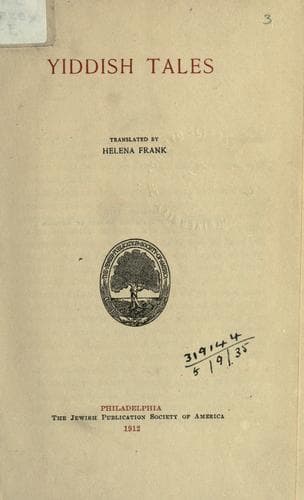
YIDDISH TALES
TRANSLATED BY
HELENA FRANK
[Illustration: colophon]
PHILADELPHIA
THE JEWISH PUBLICATION SOCIETY OF AMERICA
1912
COPYRIGHT, 1912,
BY THE JEWISH PUBLICATION SOCIETY OF AMERICA
PREFACE
This little volume is intended to be both companion and complement to
"Stories and Pictures," by I. L. Perez, published by the Jewish
Publication Society of America, in 1906.
Its object was twofold: to introduce the non-Yiddish reading public to
some of the many other Yiddish writers active in Russian Jewry, and--to
leave it with a more cheerful impression of Yiddish literature than it
receives from Perez alone. Yes, and we have collected, largely from
magazines and papers and unbound booklets, forty-eight tales by twenty
different authors. This, thanks to such kind helpers as Mr. F. Hieger,
of London, without whose aid we should never have been able to collect
the originals of these stories, Mr. Morris Meyer, of London, who most
kindly gave me the magazines, etc., in which some of them were
contained, and Mr. Israel J. Zevin, of New York, that able editor and
delightful _feuilletonist_, to whose critical knowledge of Yiddish
letters we owe so much.
Some of these writers, Perez, for example, and Sholom-Alechem, are
familiar by name to many of us already, while the reputation of others
rests, in circles enthusiastic but tragically small, on what they have
written in Hebrew.[1] Such are Berdyczewski, Jehalel, Frischmann,
Berschadski, and the silver-penned Judah Steinberg. On these last two be
peace in the Olom ho-Emess. The Olom ha-Sheker had nothing for them but
struggle and suffering and an early grave.
[1] Berschadski's "Forlorn and Forsaken," Frischmann's "Three
Who Ate," and Steinberg's "A Livelihood" and "At the Matzes," though
here translated from the Yiddish versions, were probably written in
Hebrew originally. In the case of the former two, it would seem that the
Yiddish version was made by the authors themselves, and the same may be
true of Steinberg's tales, too.
The tales given here are by no means all equal in literary merit, but
they have each its special note, its special echo from that strangely
fascinating world so often quoted, so little understood (we say it
against ourselves), the Russian Ghetto--a world in the passing, but
whose more precious elements, shining, for all who care to see them,
through every page of these unpretending tales, and mixed with less and
less of what has made their misfortune, will surely live on, free, on
the one hand, to blend with all and everything akin to them, and free,
on the other, to develop along their own lines--and this year here, next
year in Jerusalem.
Public-domain text, read in full here on John Shaqi.
Reviews
Reviews
No reviews yet
Be the first to share your thoughts on this work.
Join the Discussion
Join the discussion
Sign in to leave a comment or review.
Sign InorCreate an account