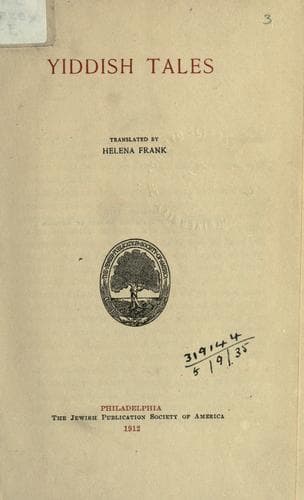
Jewish fiction; Jews -- Fiction; Short stories, Yiddish -- Translations into English
"Enough!" He ran forward with a cry, and seized the penholder.
"Three words more!" begged Berele.
"But remember, not more than three!" and Yainkele's eyes flashed. Berele
set to work to write the three words; but that which he wished to
express required yet ten to fifteen words, and Berele, excited by the
fact of writing, pecked away at the paper, and took up yet another bit
of the other half.
"You stop!" shrieked Yainkele, and broke into hysterical sobs, as he saw
what a small space remained for him.
"Hush! Just 'from me, thy son,'" begged Berele, "nothing else!"
But Yainkele, remembering that he had given a whole vierer toward the
post-card, and that they would read so much of Berele at home, and so
little of him, flew into a passion, and came and tried to tear away the
card from under Berele's hands. "Let me put 'from me, thy son'!"
implored Berele.
"It will do _without_ 'from me, thy son'!" screamed Yainkele, although
he _felt_ that one ought to put it. His anger rose, and he began tugging
at the card. Berele held tight, but Yainkele gave such a pull that the
card tore in two.
"What have you done, villain!" cried Berele, glaring at Yainkele.
"I _meant_ to do it!" wailed Yainkele.
"Oh, but why did you?" cried Berele, gazing in despair at the two torn
halves of the post-card.
But Yainkele could not answer. The tears choked him, and he threw
himself against the wall, tearing his hair. Then Berele gave way, too,
and the little room resounded with lamentations.
LOST HIS VOICE
It was in the large synagogue in Klemenke. The week-day service had come
to an end. The town cantor who sings all the prayers, even when he prays
alone, and who is longer over them than other people, had already folded
his prayer-scarf, and was humming the day's Psalm to himself, to a tune.
He sang the last words "cantorishly" high:
"And He will be our guide until death." In the last word "death" he
tried, as usual, to rise artistically to the higher octave, then to fall
very low, and to rise again almost at once into the height; but this
time he failed, the note stuck in his throat and came out false.
He got a fright, and in his fright he looked round to make sure no one
was standing beside him. Seeing only old Henoch, his alarm grew less, he
knew that old Henoch was deaf.
As he went out with his prayer-scarf and phylacteries under his arm, the
unsuccessful "death" rang in his ears and troubled him.
"Plague take it," he muttered, "it never once happened to me before."
Soon, however, he remembered that two weeks ago, on the Sabbath before
the New Moon, as he stood praying with the choristers before the altar,
nearly the same thing had happened to him when he sang "He is our God"
as a solo in the Kedushah.
Happily no one remarked it--anyway the "bass" had said nothing to him.
And the memory of the unsuccessful "Hear, O Israel" of two weeks ago and
of to-day's "unto death" were mingled together, and lay heavily on his
heart.
Public-domain text, read in full here on John Shaqi.
Reviews
Reviews
No reviews yet
Be the first to share your thoughts on this work.
Elsewhere in the archive
Join the Discussion
Join the discussion
Sign in to leave a comment or review.
Sign InorCreate an account