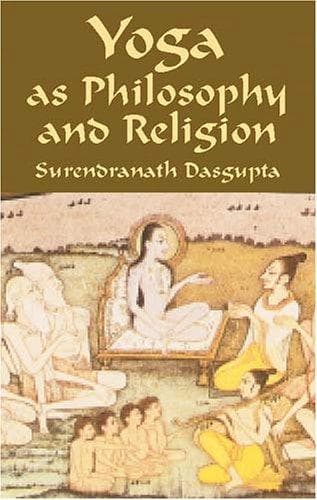
Yoga as philosophy and religionDasgupta, Surendranath
Religion
Yoga as philosophy and religion
Dasgupta, Surendranath
Hindu philosophy; Patañjali; Yoga
for concentration as described in the _sūtra_ I. 34, where it is said
that steadiness is acquired by prāṇāyāma in the same way as
concentration, as we also find in the _sūtra_ II. 53.
When the senses are restrained from their external objects by pratyāhāra
we have what is called pratyāhāra, by which the mind remains as if in
its own nature, being altogether identified with the object of inner
concentration or contemplation; and thus when the citta is again
suppressed, the senses, which have already ceased coming into contact
with other objects and become submerged in the citta, also cease along
with it. Dharaṇa is the concentration of citta on a particular place,
which is so very necessary at the time of prāṇāyāmas mentioned before.
The mind may thus be held steadfast in such places as the sphere of the
navel, the lotus of the heart, the light in the brain, the forepart of
the nose, the forepart of the tongue, and such like parts of the body.
Dhyāna is the continuance or changing flow of the mental effort in the
object of dharaṇa unmediated by any other break of conscious states.
Samādhi, or trance contemplation, results when by deep concentration
mind becomes transformed into the shape of the object of contemplation.
By pratyāhāra or power of abstraction, mind desists from all other
objects, except the one on which it is intended that it should be
centred; the Yogin, as he thus abstracts his mind, should also try to
fix it upon some internal or external object, which is called dhāraṇā;
it must also be noticed that to acquire the habit of dhāraṇā and in
order to inhibit the abstraction arising from shakiness and unsteadiness
of the body, it is necessary to practise steadfast posture and to
cultivate the prāṇāyāma. So too for the purpose of inhibiting
distractions arising from breathing. Again, before a man can hope to
attain steadfastness in these, he must desist from any conduct opposed
to the yamas, and also acquire the mental virtues stated in the niyamas,
and thus secure himself against any intrusion of distractions arising
from his mental passions. These are the indirect and remote conditions
which qualify a person for attaining dhāraṇā, dhyāna, and samādhi. A man
who through his good deeds or by the grace of God is already so much
advanced that he is naturally above all such distractions, for the
removal of which it is necessary to practise the yamas, the niyamas, the
āsanas, the prāṇāyāma and pratyāhara, may at once begin with dhāraṇā;
dhāraṇā we have seen means concentration, with the advancement of which
the mind becomes steady in repeating the object of its concentration,
i.e. thinking of that thing alone and no other thing; thus we see that
with the practice of this state called dhyāna, or meditation, in which
the mind flows steadily in that one state without any interruption,
gradually even the conscious flow of this activity ceases and the mind,
transformed into the shape of the object under concentration, becomes
steady therein.
Public-domain text, read in full here on John Shaqi.
Reviews
Reviews
No reviews yet
Be the first to share your thoughts on this work.
Elsewhere in the archive
Join the Discussion
Join the discussion
Sign in to leave a comment or review.
Sign InorCreate an account